
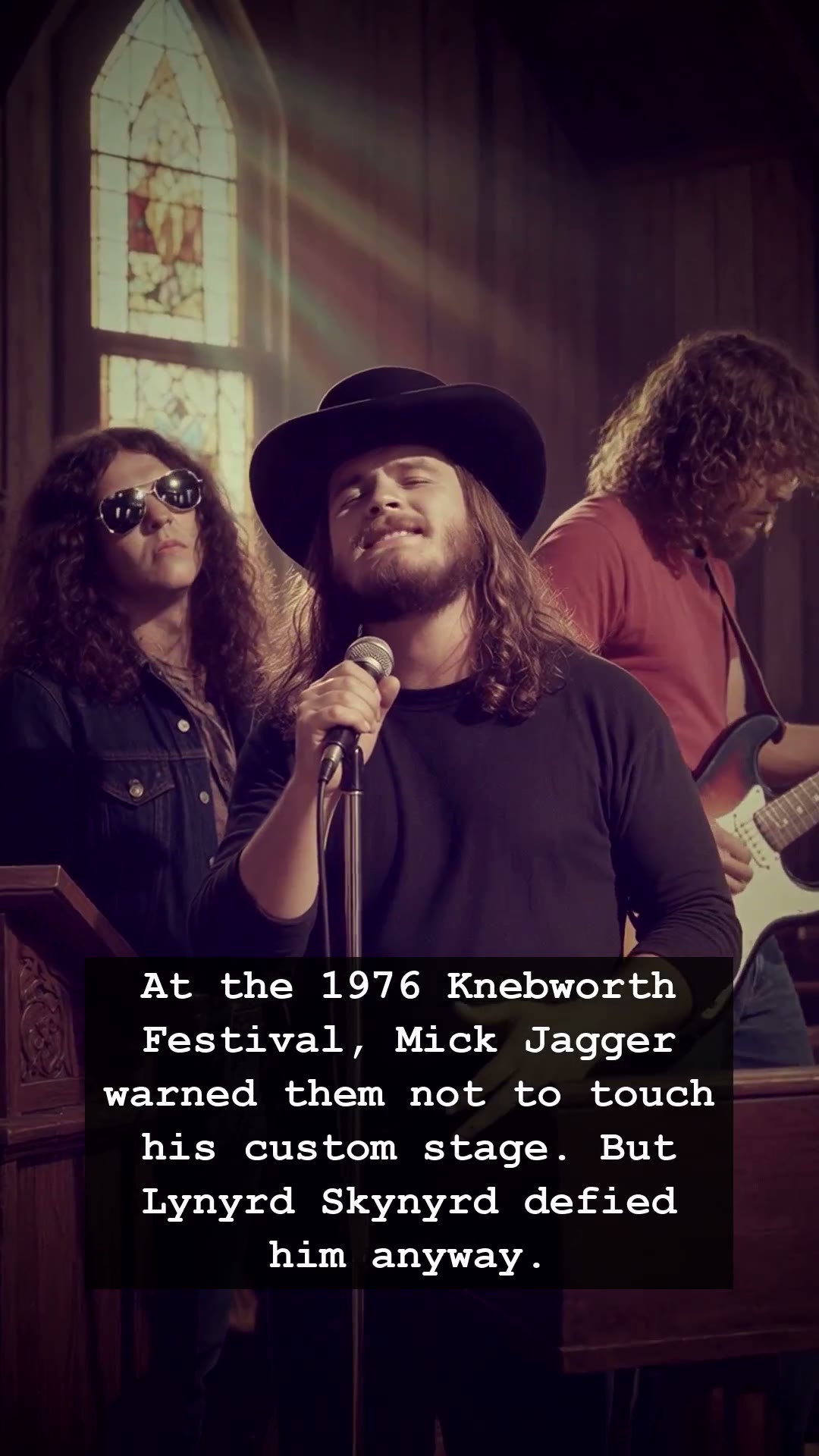
The year was 1976, and the air at the Knebworth Festival in England was thick with tension, cigarette smoke, and the heavy humidity of a legendary rock spectacle. For the young upstarts of Lynyrd Skynyrd, this was their moment to prove that the raw, gritty power of the American South could hold its own against the established royalty of British rock. Mick Jagger, the definitive frontman of The Rolling Stones, had made his position crystal clear before the show: his custom-built catwalk was strictly off-limits. To Jagger, that stage was his domain, a personal throne of sorts designed for his specific brand of strutting showmanship. But Ronnie Van Zant and the boys from Jacksonville, Florida, were never ones to play by the rules of old-school rock aristocracy.
As Lynyrd Skynyrd stepped into the spotlight, the sheer audacity of the moment took the massive crowd by surprise. Ronnie Van Zant, radiating a cool, defiant confidence, looked at his bandmates and then toward the forbidden territory. With a smirk that signaled the beginning of a musical mutiny, Van Zant led the band right down that restricted catwalk. The audience, expecting a polite opening set, was suddenly treated to a masterclass in Southern rock rebellion. They weren’t just playing music; they were claiming territory. By the time the final chords of Free Bird echoed across the English countryside, it was clear that Lynyrd Skynyrd had not just performed; they had effectively stolen the entire show right from under the nose of rock’s biggest icon.
This incident at Knebworth serves as a perfect microcosm of the mid-70s rock culture, a time when ego, music, and performance were inextricably linked. The era was defined by these high-stakes clashes where bands weren’t just competing for airtime on the radio or space on a turntable; they were competing for the crown of the live concert circuit. Lynyrd Skynyrd represented the blue-collar, sweat-soaked reality that stood in stark contrast to the glitz and high-production value that artists like The Rolling Stones were perfecting. This collision of styles and temperaments is exactly what made that specific decade of rock history so volatile and magnetic.
Today, looking back through the lens of music history, the defiance of Lynyrd Skynyrd feels like a pivotal turning point. It was a moment where the authenticity of the American spirit refused to be sidelined by British rock prestige. The memory of Van Zant striding across that stage remains etched in the minds of those who were there, a testament to the band’s refusal to shrink for anyone. It was the grit of the Jukebox era meeting the grand stage of the stadium rock boom, creating a friction that still sparks excitement for fans decades later.
Ultimately, the Knebworth story is a reminder of why we remain so obsessed with the legends of the 70s. It wasn’t just about the chords or the lyrics; it was about the stories of rebellion that happened in the shadows of the spotlight. Lynyrd Skynyrd taught us that sometimes, the best way to make a mark is to ignore the velvet ropes, walk your own path, and let the music do the talking. While the stage at Knebworth eventually faded into history, the echoes of that bold, unforgettable afternoon continue to resonate with every listener who cherishes the untamed soul of classic rock.