
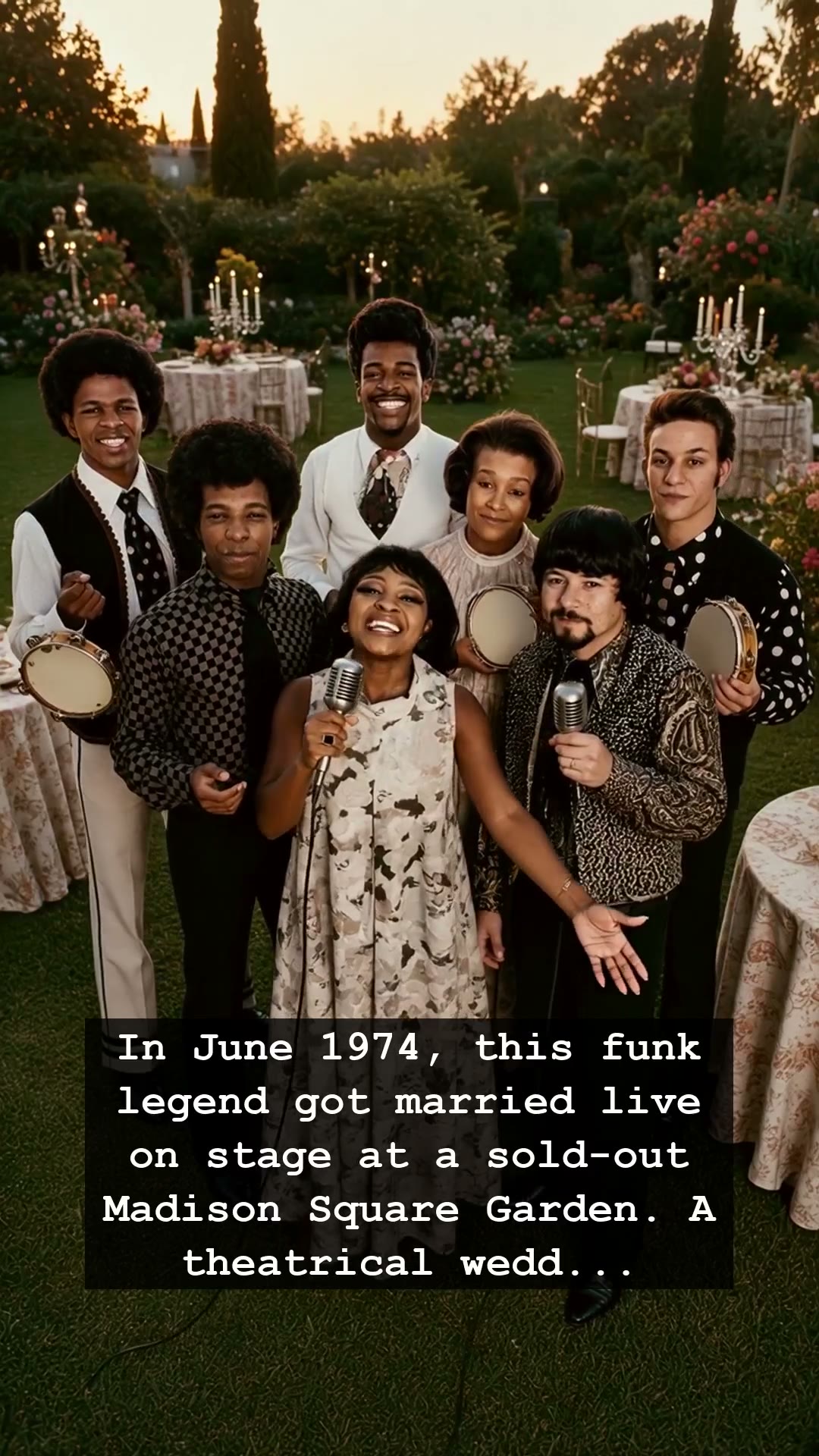
It was June 1974, and the air inside Madison Square Garden was thick with the scent of marijuana, expensive perfume, and the sheer, humid electricity of a New York City summer. Twenty-one thousand fans had packed the arena, expecting a transcendent funk performance from the visionary Sly Stone. What they got instead was a spectacle that bypassed the boundaries of a typical concert and dipped straight into the surreal. In the middle of a set that pulsated with the raw, rhythmic genius of Sly and the Family Stone, the music slowed to a hypnotic crawl. Without warning, the stage transformed from a platform of sound into a makeshift altar. Sly Stone, the pioneer of psychedelic soul, decided that this was the perfect moment to wed his partner, Kathy Silva, in front of a sold-out crowd. It was chaotic, it was theatrical, and for a brief, breathless moment, twenty-one thousand people were invited to witness a piece of history that felt more like a fever dream than a celebration of love.
To understand the gravity of that night, one must look at the cultural landscape of the era. Sly Stone was at the absolute peak of his influence, a man who had successfully blended funk, rock, and social consciousness into a sound that bridged the gap between the civil rights movement and the disco-fueled excess that would soon dominate the late seventies. The Madison Square Garden wedding remains one of the most baffling and iconic moments in music history, a testament to the ego, brilliance, and volatility that defined the legend of Sly Stone. While the critics and the press were caught off guard by this impulsive act of public intimacy, the fans in the front row felt the tremor of a man who was operating on a frequency entirely his own, far removed from the constraints of traditional fame.
Yet, the glitz of that night served as a mask for the deep-seated pressures brewing behind the curtain. The mid-seventies were a time when the myth of the rock star was reaching its breaking point. For Sly Stone, the constant demand for genius combined with the isolating nature of superstardom had begun to take its toll. The wedding was, perhaps, an attempt to ground himself in reality, or perhaps just another grand act of rebellion against the industry that expected him to be a commodity rather than a human being. Behind the scenes, the cracks were already starting to show, marking the beginning of the end for the original incarnation of the Family Stone.
Decades later, the memory of that night at the Garden still lingers, serving as a reminder of an era when rock and funk icons felt like gods capable of rewriting the rules of reality. It was a time of excess, where the lines between performance art and personal life were blurred by the heavy fog of the seventies. As the years have passed, the legend of Sly Stone has only grown, colored by the bittersweet realization that even the brightest stars are often burning out the fastest. That wedding at Madison Square Garden wasn’t just a marriage; it was a snapshot of a man who lived with his heart on his sleeve and his soul on the stage, forever leaving his mark on the pantheon of music history.