
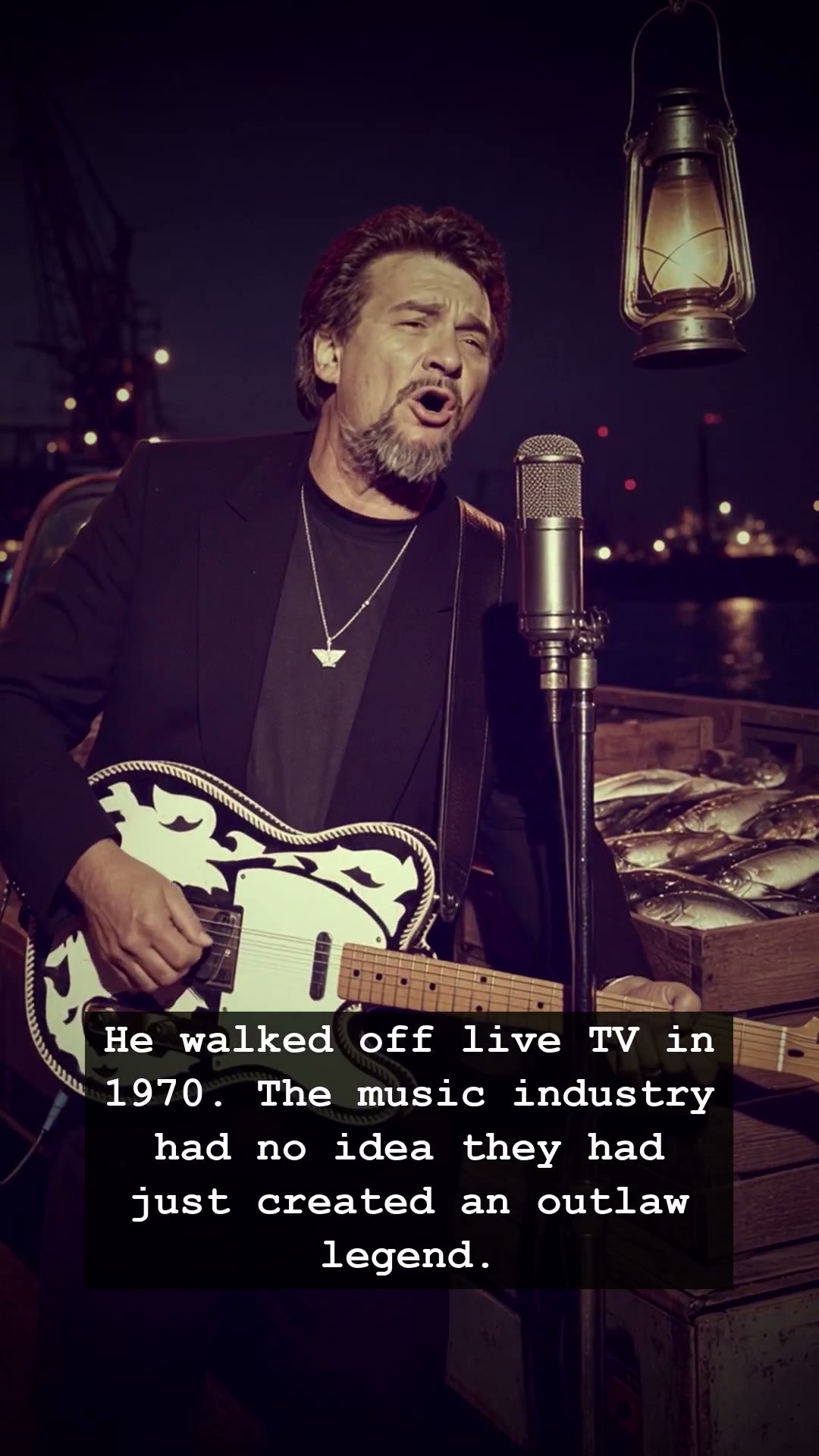
The year was 1970, and the stage was set for a polished, highly controlled television performance. The bright studio lights of the era, much like the rigid machinery of Nashville’s music industry, demanded perfection and conformity. But as the cameras rolled, Waylon Jennings did something that would send shockwaves through the country music world. In an act of pure, unfiltered defiance, he simply walked off the live set. To the producers, it looked like a catastrophic disruption. To history, it was the birth of an outlaw legend, a moment where a man finally drew a line in the sand between his soul and the corporate polish of Music Row.
At the time, the industry was suffocating under the weight of Nashville Sound production, which favored smooth, predictable arrangements designed to pacify the masses. Waylon Jennings, however, was a man with a wild spirit and a deep-seated contempt for the suits who tried to dictate how his records should sound. He felt trapped by the glossy production values that stripped the grit away from his storytelling. Walking off that stage wasn’t just about a single performance; it was a rejection of the entire system that viewed artists as mere products, much like the mass-marketed items filling the shelves of the era’s booming retail landscape.
This act of rebellion crystallized the Outlaw Country movement. Along with kindred spirits like Willie Nelson, Waylon Jennings stopped playing by the rules. He stopped using the prescribed session musicians and insisted on using his own band. He pushed for creative control that was virtually unheard of for an artist in the early seventies. He traded the stiff, choreographed atmosphere of network television for the smoke-filled, raw energy of the honky-tonk circuit. This was a man who preferred the honest wear of a worn-out denim jacket to the sequins and stiff collars expected of country stars at the time.
Why does this moment still resonate today? Because Waylon Jennings represented a brand of authenticity that feels increasingly rare in our hyper-curated modern world. He proved that an artist could survive, and even thrive, by saying no to the machine. His legacy is etched into every scratch of a vinyl record playing on a classic turntable and echoes in the rebellious spirit of every songwriter who refuses to compromise their vision for a quicker payday. He reminded us that the cost of integrity is high, but the price of losing oneself to the industry is far higher.
When we look back at the era of the walkman and the slow crawl of the jukebox, we see the faces of artists who fought for their right to be human. Waylon Jennings wasn’t just a voice; he was a mirror for the restless hearts of the generation. He stripped away the pretense to reveal the man underneath—flawed, frustrated, and undeniably bold. As his deep, resonant baritone continues to filter through our speakers decades later, we aren’t just listening to music; we are listening to a manifesto of freedom. The man who walked off the screen that night never looked back, and in doing so, he taught us that sometimes the most powerful thing you can do is simply walk away from everything that doesn’t feel like you.