
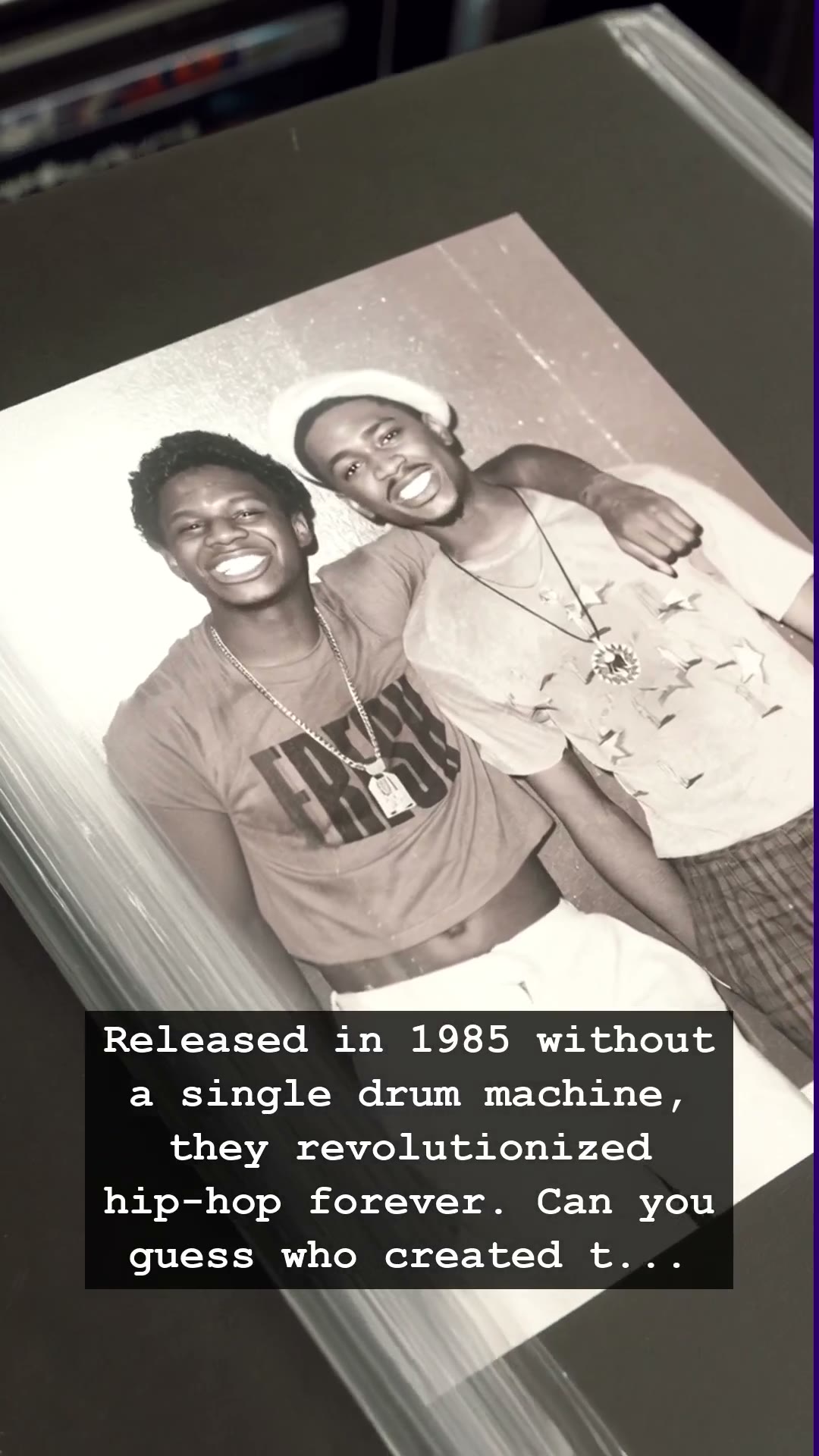
It was 1985, an era defined by the neon glow of early MTV and the scratchy, analog warmth of the boombox on every street corner. While the industry was frantically racing to incorporate the latest heavy-duty drum machines and synthesizers, two young visionaries in New York City decided to take a radical path in the opposite direction. They stripped away the machines, the backing tracks, and the studio polish to focus on the rawest instrument of all: the human voice. This is the story of how Slick Rick and Doug E. Fresh created a sonic miracle that didn’t just top the charts, but fundamentally altered the DNA of hip-hop forever.
The track, The Show, was an anomaly. It hit the airwaves without a single drum machine, relying instead on the incredible, rhythmic beatboxing of Doug E. Fresh. His mouth became the percussion section, a feat of human engineering that left listeners stunned. Paired with the distinct, melodic storytelling style of Slick Rick, the song felt like a transmission from a different dimension. In an age where producers were obsessed with the digital revolution, these two artists proved that the most powerful technology in the room was their own creativity. It was a minimalist masterpiece that echoed through the concrete canyons of Harlem and eventually the entire world.
Behind the scenes, the energy was electric. The chemistry between Doug E. Fresh and Slick Rick was undeniable, yet it carried the heavy weight of the budding hip-hop industry. This was a time when the genre was still fighting for its seat at the table, struggling to move beyond the club circuit and into the mainstream consciousness. The success of their collaboration provided a massive turning point for the culture. It validated the idea that rappers were not just talking over beats, but were musicians in the truest sense of the word. They were performers who could command a room with nothing but a microphone and a vision.
For those of us who remember the era of the Walkman and the constant hum of a Jukebox in a local diner, the impact of this song was visceral. It made us look at our own potential. If Slick Rick could paint such vivid, complex narratives with his unique vocal inflection, and if Doug E. Fresh could turn his own body into a musical instrument, what could we do? The record captured the spirit of the mid-80s perfectly: inventive, daring, and unapologetically cool. It was a bridge between the street corners and the stadium, proving that the most revolutionary music is often the kind that relies on nothing but talent.
Looking back, it is easy to see why this moment remains a cornerstone of musical history. It reminds us of a time when hip-hop was an exploration, not just a formula. Today, whenever we hear the mimicry of a drum kit, we are listening to the echoes of that 1985 miracle. Slick Rick and Doug E. Fresh did more than record a song; they set a standard for authenticity that has rarely been matched since. As the decades pass, their influence remains as sharp as that first beatbox rhythm, a timeless reminder that when it comes to true artistry, less is often infinitely more.