
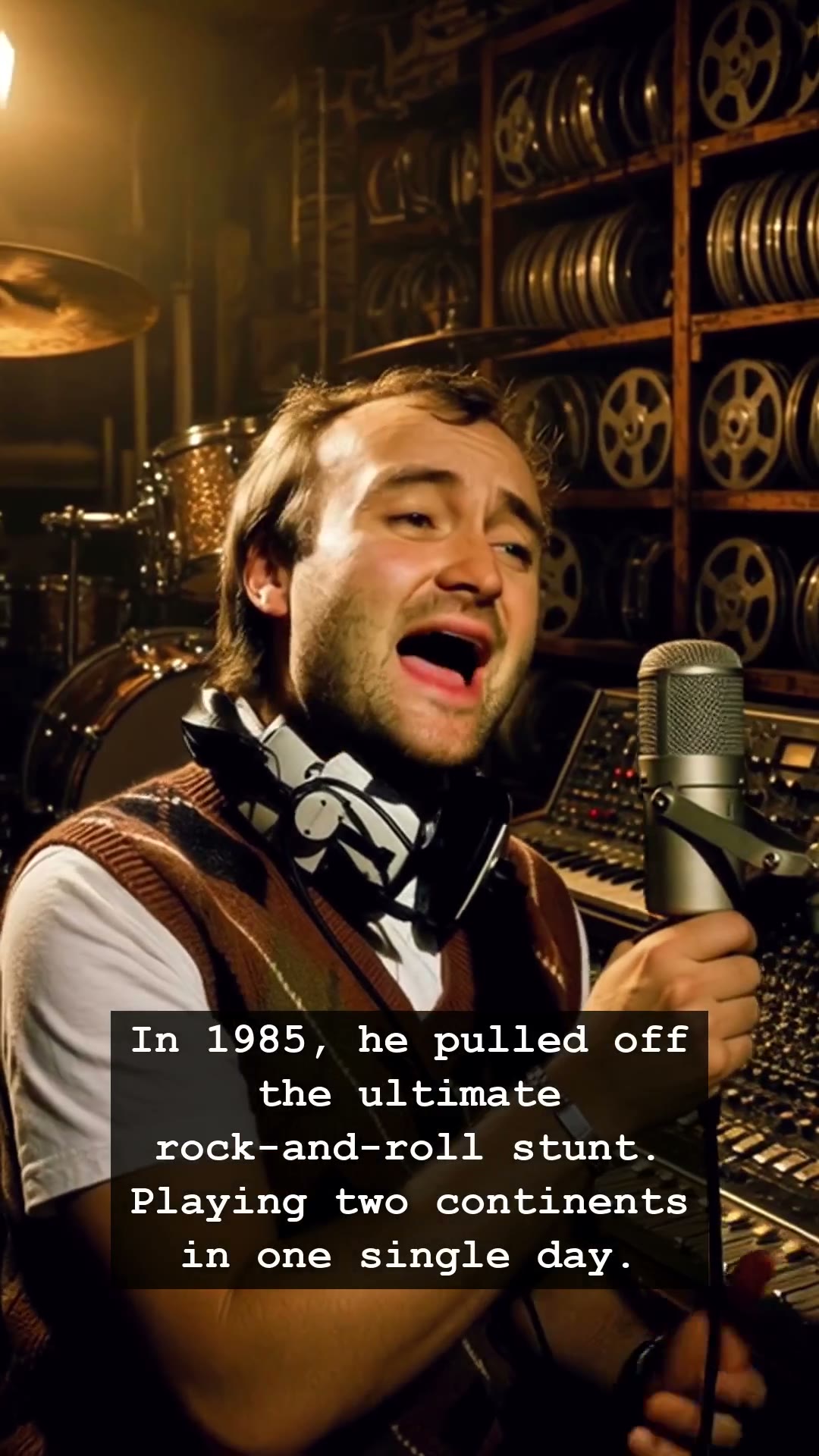
It was July 13th, 1985, a day when the world felt smaller, tighter, and infinitely more electric. While the glitter of Studio 54 had begun to fade and the world was just getting used to the tether of the Walkman, one man stood at the center of a logistical nightmare that defied the laws of physics. Phil Collins, the powerhouse drummer and solo star of the decade, decided that being a legendary musician wasn’t quite enough. He wanted to be a pioneer of speed. As the global broadcast of Live Aid flickered across millions of television sets, Phil Collins embarked on a journey that would cement his name in the annals of rock and roll excess, proving that when you have the world watching, you do the impossible.
The premise sounds like a fever dream today. Phil Collins was slated to perform at Wembley Stadium in London. But he wasn’t just a British icon; he was a global force. Driven by a relentless work ethic and perhaps a touch of madness, he hopped onto a supersonic Concorde immediately after his set. His destination? Philadelphia. He was attempting the ultimate rock-and-roll stunt: performing on two separate continents in the span of a single calendar day. In an era before the instant connectivity of the internet, this felt like science fiction, a feat of logistics that made the cold, sleek frame of the Concorde look like a chariot of the gods.
When we look back at the eighties, we often remember the neon lights, the synth-pop synthesizers, and the sheer saturation of pop culture. Yet, the story of Phil Collins on that summer day hits differently. It captures the frantic, high-stakes energy of a time when music legends were treated like royalty. There was a raw, unfiltered intensity to the experience, an era where the stage was the ultimate battlefield and every performance was a high-wire act without a net. For those of us watching from home, it felt as though the rhythm of the drums was literally pulse-syncing with the planet.
Beyond the glitz of the stunt lay the man himself. Phil Collins was coming off a period of immense personal and professional shifts, his artistry evolving from the prog-rock complexity of Genesis into the sharp, radio-ready soul of his solo career. To see him transition from the grandeur of a Wembley stage to the electric tension of the Philadelphia arena was to see the metamorphosis of eighties celebrity. It was chaotic, exhausting, and undeniably cool, a moment that bridged the distance between fans in a way that modern social media can only dream of mimicking.
Even now, the legend of that July day refuses to die. It reminds us of a time when rock stars were larger than life, fueled by ambition and the sheer adrenaline of the music industry. Phil Collins didn’t just play two concerts; he pushed the boundaries of what a musician could be. As we look back, we realize that the magic wasn’t just in the Concorde, but in the sheer audacity to try. Do you remember where you were when the world seemed to stop for the beat of a drum?