
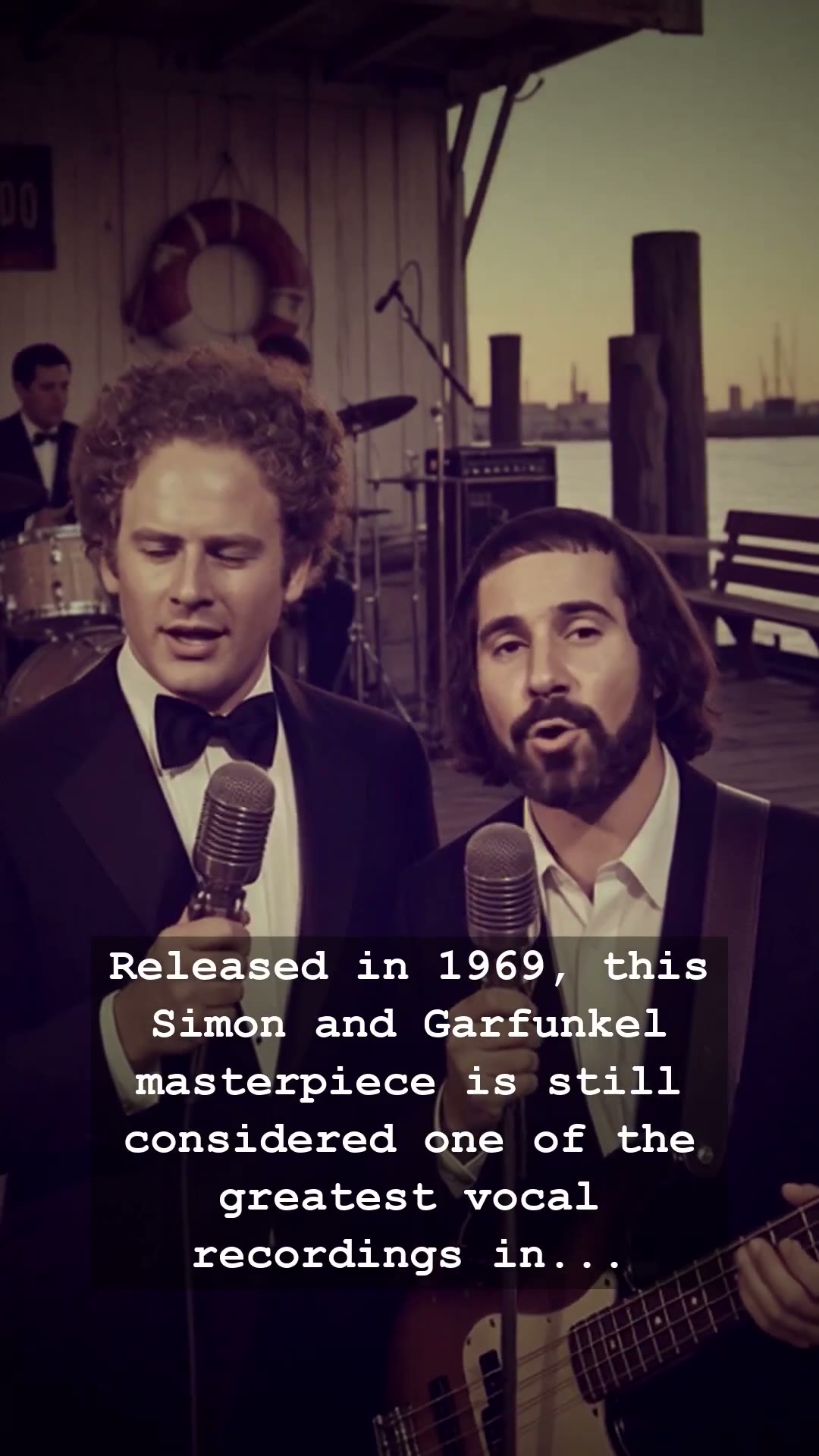
It was 1969, a year defined by the crumbling idealism of the decade, the moon landing, and the echoing silence left by the Woodstock festival. Amidst this cultural turbulence, Simon and Garfunkel retreated into the studio to craft what would become their swan song, Bridge Over Troubled Water. While the world heard a soothing lullaby of comfort, few knew that the recording process was actually a battlefield, mirroring the fragile state of the duo’s own disintegrating partnership. Paul Simon, the meticulous architect, and Art Garfunkel, the soaring voice, were already drifting into separate orbits, yet they managed to create a masterpiece that transcended their internal chaos to become the definitive anthem of a generation.
To understand the weight of the song, one must look at the tension vibrating through the studio air. Art Garfunkel had been away filming Catch-22, leaving Paul Simon to struggle with the weight of expectation. When Garfunkel finally returned, he was asked to lend his angelic, multi-layered vocals to the track. Simon, perhaps sensing that his creative partner was moving toward a life in acting, reportedly expressed deep-seated resentment over the fact that it was Garfunkel’s voice, rather than his own, that would forever be synonymous with this hymn of empathy. This friction, hidden beneath the polished production, gave the recording its uniquely haunting, almost mournful quality that listeners still feel today.
Released in early 1970, the track hit the airwaves just as the Sixties ended, serving as a solemn bridge to the uncertainty of the next decade. It was the era of the Sony Walkman’s precursor, the transition from mono to stereo, and the lingering influence of the folk-rock movement. The song became a sanctuary for millions. Its sparse piano arrangement, inspired by gospel music, stood in stark contrast to the emerging, chaotic roar of hard rock and heavy metal that was beginning to dominate the charts. It was a moment of vulnerability in an era increasingly obsessed with louder, faster, and more aggressive sounds.
Decades later, the emotional resonance of Bridge Over Troubled Water has not faded. It remains a testament to the idea that great art is often born from the friction of two opposing forces. Paul Simon’s brilliance in composition combined with Art Garfunkel’s ability to infuse a song with profound humanity resulted in something that felt inevitable, even if the men behind it were destined to walk different paths. Every time the piano keys strike, it transports us back to that pivotal moment in musical history where pop music reached a level of sophistication rarely seen since.
Ultimately, the legacy of Simon and Garfunkel is a reminder that even the most beautiful connections are not immune to the wear and tear of time and ambition. Whether you first heard it through a crackling radio or on a modern streaming service, the song remains a beacon of grace. As we look back at the late sixties, we find not just a melody, but a mirror reflecting our own human complexities. Do you remember where you were the first time those soaring vocals washed over you?