
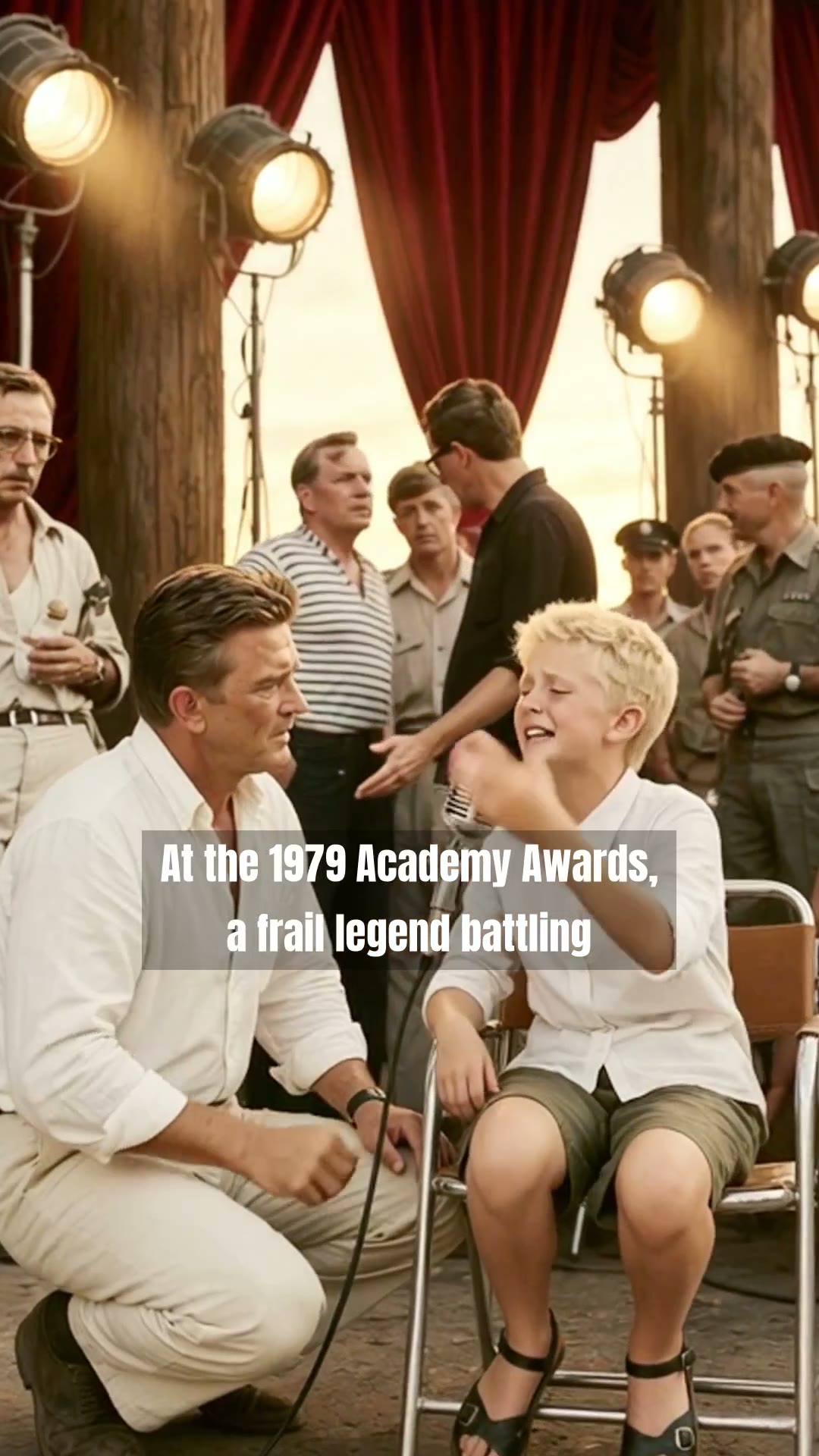
In the annals of Golden Age Hollywood, few figures loom as large as John Wayne. Known to the world as The Duke, he was the personification of the American frontier, a man whose rugged silhouette against a desert sunset defined the Western genre for decades. Yet, beyond the grit and the legendary roles, there was a man of profound resilience. Nowhere was this more evident than on a humid April night in 1979, during the 52nd Academy Awards, when a frail, cancer-stricken John Wayne stepped onto the stage for what would be his final public appearance, leaving an indelible mark on the hearts of all who witnessed it.
By the late seventies, the era of the massive studio-produced blockbuster was shifting, and the landscape of cinema was rapidly changing. John Wayne, however, remained a steadfast constant, a bridge to a bygone era of classic storytelling. When he walked out to present the award for Best Picture, the audience did not see the invincible hero of The Searchers or True Grit. They saw a man battling terminal illness, his frame diminished by time and pain. The sight of him caused the entire Dorothy Chandler Pavilion to erupt in a thunderous, prolonged standing ovation that transcended simple applause; it was an act of collective love, a final salute to an icon who had carried the silver screen on his shoulders for half a century.
It is difficult for modern audiences to fully grasp what John Wayne represented to the generations of the mid-20th century. In an age before the convenience of digital streaming, we cherished our memories of him through the magnetic hum of a VCR and the tangible texture of a VHS tape. We grew up watching his films on lazy Sunday afternoons, mesmerized by his signature walk and the quiet authority in his voice. His presence on that Oscar night was a poignant reminder that even the strongest icons are human, and that there is a quiet, dignified heroism in facing one’s mortality with grace.
His performance that night was not about acting or the art of Method Acting that had come to define the later New Hollywood era; it was about the man himself. He stood tall, despite the physical agony, and spoke with the same steady, commanding resonance that had charmed moviegoers since the 1930s. He cracked a joke about his health, a trademark display of his indomitable spirit, and in that fleeting moment, he reminded us all why he held such a permanent place on the Hollywood Walk of Fame. It was a masterclass in courage, delivered not under the lens of a director, but under the spotlight of real life.
Decades later, the legacy of John Wayne remains anchored in the cultural bedrock of American cinema. We return to his films not just for the nostalgia of a simpler time, but to connect with the values of integrity and perseverance that he embodied. As we look back at that final bow in 1979, we are reminded that true legends never really leave us; they simply move into the history books, waiting for the next generation to discover the magic of their story. Let us keep the light of the silver screen burning, forever honoring the giants who paved the way.