
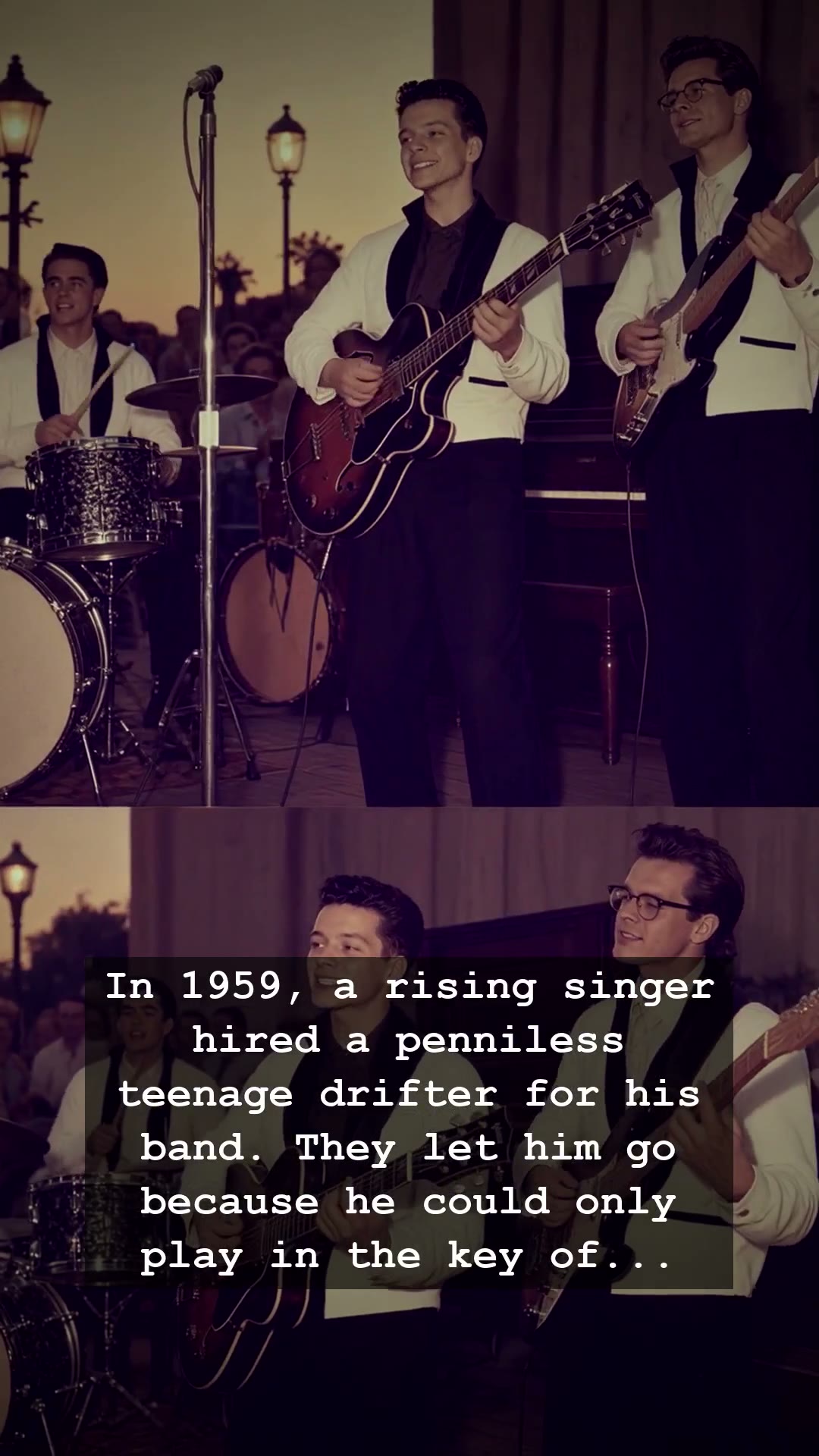
It was 1959, an era where the hum of a jukebox in a roadside diner was the heartbeat of American youth. Teen idol Bobby Vee was rising fast, a golden boy with a clean-cut image that screamed early rock and roll success. He needed a piano player for his band, and in a moment of desperate pragmatism, he hired a scruffy, penniless drifter who claimed he could tickle the ivories. The young man went by the name Elston Gunnn, a nomadic runaway searching for his place in a rapidly changing world. Little did Bobby Vee know, the person sitting at his piano bench was the man who would eventually redefine the soul of American music: Bob Dylan.
The collaboration was as brief as it was catastrophic. During their short stint together, it quickly became apparent that this mysterious drifter had a severely limited repertoire. While Bobby Vee was aiming for professional perfection, the young Bob Dylan could seemingly only play in the key of C. The frustration in the band was palpable. In the tight, fast-paced world of local tours and amateur gigs, there was no time for a musician who couldn’t keep up with the shifting chords of popular hits. With a heavy sigh and a decision that would haunt music trivia buffs for decades, Bobby Vee let the runaway go. They parted ways, one destined for the polished stage of mainstream pop and the other for the grit and poetry of the folk movement.
Looking back at that era, it is easy to romanticize the chaotic nature of the late 1950s. This was a time before the complex synthesis of the synth-pop years or the rebellious distortion of the grunge movement. It was a time of simple melodies, hair gel, and the dream of stardom that lured thousands of young people toward the neon lights of big cities. Bobby Vee was the perfect representation of that polished dream, while Bob Dylan represented the raw, unwashed truth that was waiting just around the corner. If you had walked into that rehearsal space, you would have seen a snapshot of history unfolding—a moment where destiny intersected with mundane band politics.
Why does this story continue to resonate with us today? Perhaps it is because it serves as a powerful reminder of how fragile and accidental greatness can be. Bob Dylan’s inability to play beyond the key of C was not a mark of incompetence, but rather a mark of an artist who hadn’t yet found his voice in the structured world of pop covers. He needed to be fired, to walk away from that piano, and to head toward the Greenwich Village folk scene to find his true frequency. The rejection was the catalyst that pushed a drifter into the history books.
Decades later, Bob Dylan himself would reflect on his admiration for Bobby Vee, proving that life comes full circle in the most poetic ways. While the world of MTV and the high-production eras that followed would eventually overshadow the innocence of 1959, these stories remain the bedrock of music history. They remind us that every legend was once a nervous kid hitting the wrong notes. Next time you listen to a classic record, remember that behind every hit, there is a story of a rejection that changed the course of sound forever.