
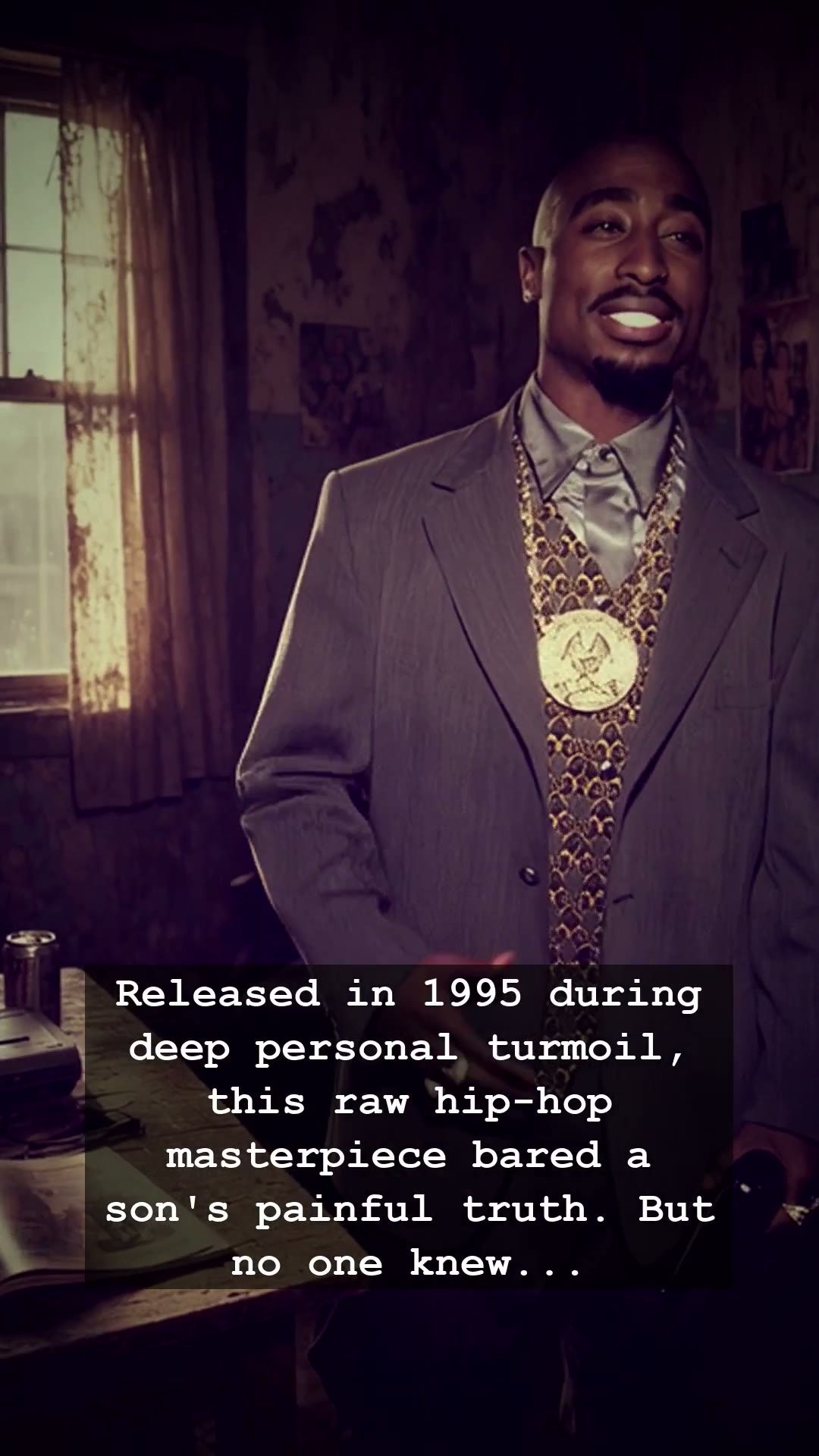
In the golden age of hip-hop, where bravado and street toughness were the armor worn by every emcee, one man dared to do the unthinkable: he wept for his mother. It was 1995, a year defined by the hum of the Walkman and the rising tension between the East and West Coast factions. While the radio waves were crowded with aggressive posturing, Tupac Shakur stepped into the booth to record a testament of unconditional love. The song was Dear Mama, a masterpiece that stripped away the gangsta rap facade to reveal a deeply wounded, sensitive son. Yet, beneath the smooth production lay a reality that the world didn’t understand, and a truth that Tupac feared would haunt his mother forever.
To understand the gravity of the song, one must look at the chaotic backdrop of the nineties. Tupac Shakur was a man caught in a relentless cycle of legal battles, industry rivalries, and the crushing weight of global fame. He was navigating a life where danger lurked around every corner of the studio, yet his mind was tethered to the complex, turbulent relationship he shared with Afeni Shakur. As a Black Panther activist battling her own inner demons and substance abuse, Afeni was a woman of immense strength and profound vulnerability. When Tupac penned those lyrics, he wasn’t just writing a hit; he was conducting an autopsy of his own upbringing in the shadow of poverty and oppression.
The genius of Tupac Shakur was his ability to hold two opposing worlds in his hands: the rage of the street and the tenderness of a poet. When he laid down the track, he knew he was breaking an unspoken rule of the era. Hip-hop was supposed to be about the grind and the come-up, not a public confession of childhood trauma. But Tupac didn’t care for industry standards. He delivered lines that cut like a knife, admitting his own mistakes and honoring his mother’s survival. The chilling part? He recorded the song while his life was unraveling, unsure if his mother would be offended or devastated by the public exposure of their most private, painful struggles.
When Dear Mama hit the airwaves, the cultural impact was seismic. It became a bridge between the street corners and the living rooms of America, proving that hip-hop could be a vessel for raw, unfiltered human emotion. Fans who grew up in the MTV generation remember the feeling of hearing that beat for the first time—a melancholy piano loop that felt like a heartbeat. It was a moment of collective realization that behind the tattoos and the jewelry, Tupac Shakur was just a son longing for connection in a world that often refused to give him space to breathe.
Years have passed, the golden era of hip-hop has receded into memory, and the legends have faded, but the resonance of this track remains undiminished. Tupac Shakur left us with a blueprint for vulnerability, showing that the strongest people are often those willing to carry their scars into the light. Today, when we listen to Dear Mama, we aren’t just hearing a song; we are witnessing a man documenting his soul. It remains a poignant reminder that even in the most hardened hearts, love is the only true legacy worth leaving behind. Do you remember where you were when you first heard it?