
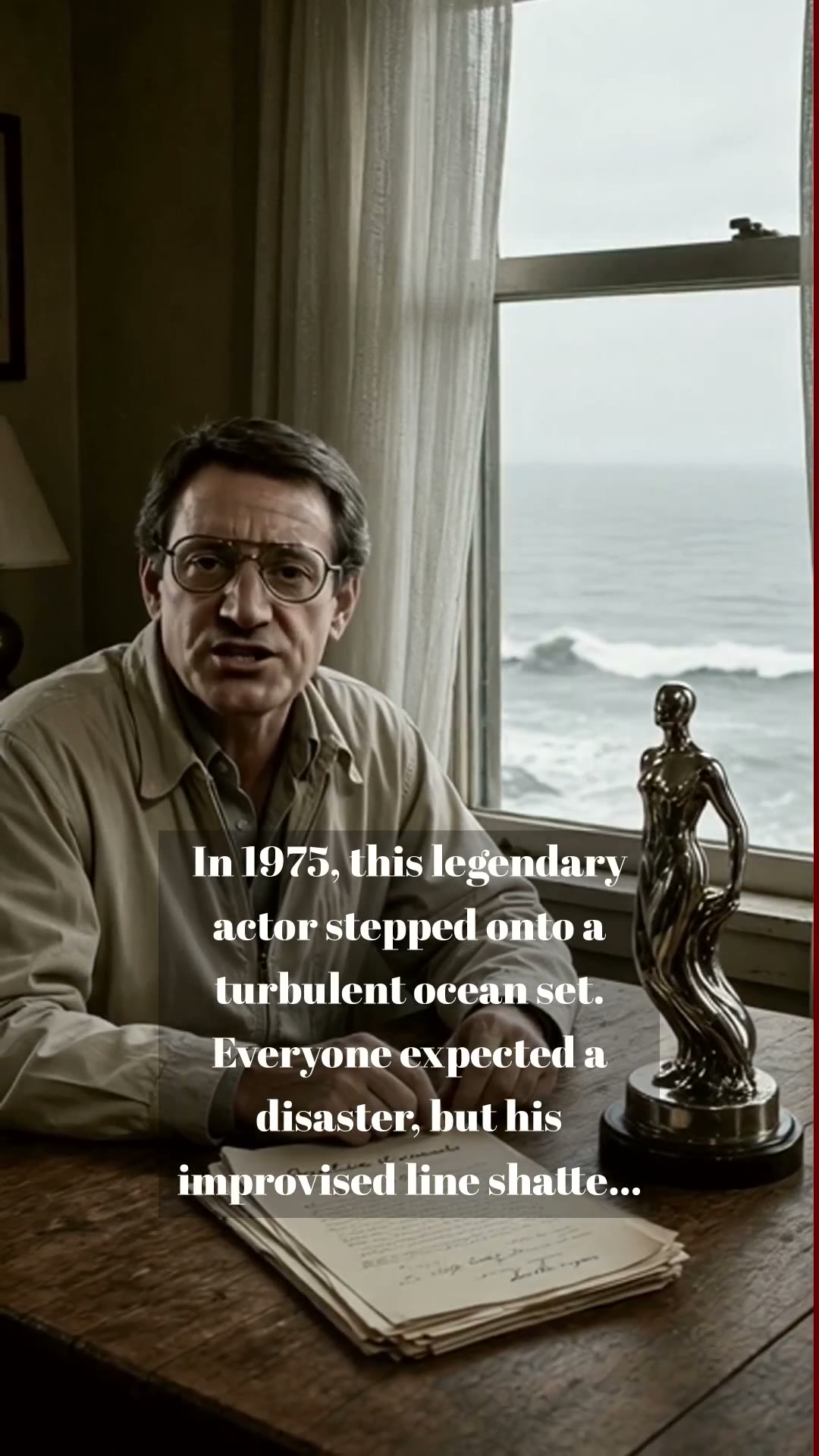
In the sweltering summer of 1975, the film industry was holding its breath. A production plagued by technical malfunctions, sinking mechanical sharks, and a runaway budget was widely whispered to be a disaster in the making. Yet, amidst the turbulent waters of Martha’s Vineyard, an actor named Roy Scheider stood his ground, delivering a performance that would anchor the entire film. As the police chief Martin Brody, Scheider brought a grounded, weary humanity to a picture that was rapidly becoming the first true summer blockbuster. His portrayal defined the soul of the film, proving that even in a story about a monstrous predator, the heartbeat of cinema lies in the vulnerability of the men facing it.
The magic of that production—the iconic Jaws—often focuses on the mechanical flaws, but it was the quiet intensity of Roy Scheider that steered the ship. One particular moment remains etched in the annals of Hollywood history, a testament to his instincts as a master of his craft. As he watched the massive great white shark glide past his small boat, completely unscripted and fueled by the genuine tension of the moment, Scheider uttered a line that was not in the original screenplay: You’re gonna need a bigger boat. It was a spontaneous, perfect observation that shattered box office records and became one of the most quoted lines in the history of the silver screen.
Roy Scheider was more than just a face in a hit movie; he was a quintessential character actor from a generation that valued the grit of Method Acting and the weight of genuine emotional stakes. Before he became the man who faced the shark, he had already carved out a reputation for excellence, notably with his Oscar-nominated turn in The French Connection. His career spanned the evolution of Hollywood from the tail end of the Golden Age to the grit of the 1970s and the slick high-concept thrills of the 1980s. Whether on VHS tapes that lined our living room shelves or the flickering light of an Oscar night ceremony, his presence was synonymous with reliability and intensity.
Looking back at his legacy, we see a man who eschewed the flashy vanity of the typical leading man. Instead, Roy Scheider offered something far more enduring: the feeling of a real person caught in extraordinary circumstances. His work reminds us of a time when films were measured by their narrative pulse rather than just their marketing reach. He helped pave the way for the era of the blockbuster, transforming the cultural landscape in a way that continues to influence directors and actors today.
As we revisit the classics, the name Roy Scheider carries a weight of deep, respectful admiration. He was a craftsman who showed us that the most memorable lines aren’t always written in ink, but born from the urgency of the moment. We invite you to dust off those old tapes or cue up a digital stream tonight; let’s turn back the clock to 1975 and remember the man who stood on the deck and reminded us all that sometimes, you truly do need a bigger boat.