
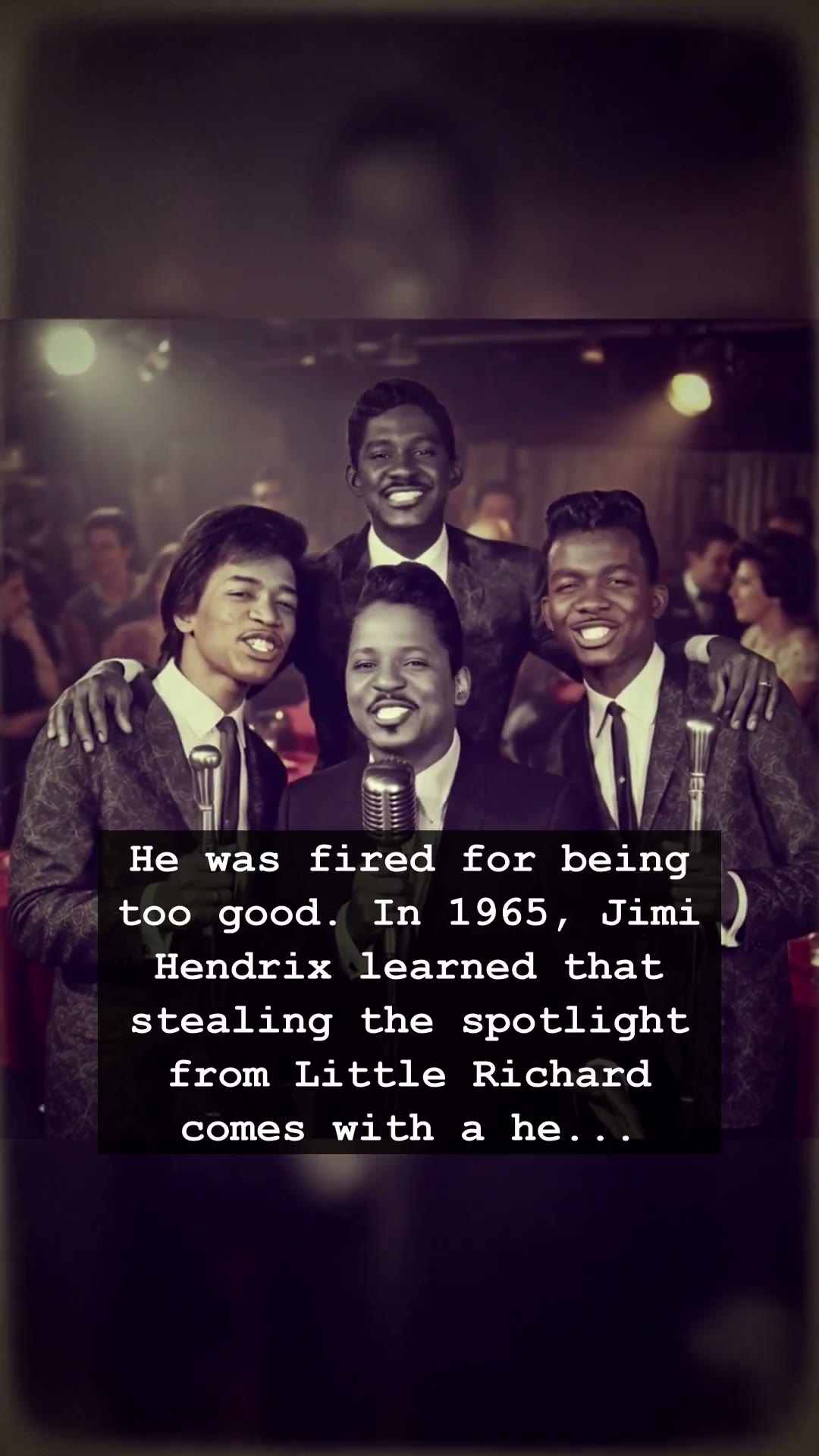
In the polished, tuxedo-clad world of mid-1960s R&B, there was no star bigger than Little Richard. He was the architect of rock and roll, a flamboyant whirlwind of charisma and ego. But in 1965, his backing band, the Upsetters, had a secret weapon that would eventually change the face of music forever. A quiet, unassuming guitarist named Jimi Hendrix had joined the ranks, draped in plain suits, trying to blend into the shadows. Yet, the moment the music started, the shadow was not enough to contain the electric fire burning in his fingertips.
Jimi Hendrix was never meant to be a sidekick. On stage, his fingers danced across the fretboard with a ferocity that defied the era’s rigid conventions. While Little Richard was busy commanding the spotlight, the audience’s eyes began to drift. They were mesmerized by this mysterious young man who played the guitar behind his head and flirted with feedback in ways no one had ever dared. He wasn’t just playing; he was manifesting a new reality, one where the guitar was a weapon of mass expression. Little Richard, a man who built his career on being the loudest person in any room, did not take kindly to being upstaged.
The tension simmered beneath the surface of every tour bus ride and every cold hotel room. For Jimi Hendrix, the constraints of being a supporting player were suffocating. He was often fined for being late, for his flashy stage antics, or for simply drawing too much applause. The breaking point arrived with a swift, cold finality: Jimi Hendrix was fired for the crime of being too good. He was deemed a distraction, an uncontrollable variable in a business that prioritized the frontman’s ego above musical evolution. He was left on the side of the road with nothing but his instrument and a head full of sounds that the world wasn’t quite ready for yet.
Looking back, it is hard to imagine a world where Jimi Hendrix was considered a liability. That abrupt firing was the catalyst that propelled him from the fringes of a backup band into the neon glow of Greenwich Village and, eventually, the hallowed grounds of Woodstock. Had he stayed in the shadow of Little Richard, we might never have experienced the psychedelic odyssey of Are You Experienced or the earth-shattering distortion of his later work. His exile from the R&B circuit was the necessary heartbreak that allowed his genius to fully ignite.
The story of Jimi Hendrix in 1965 serves as a poignant reminder that true innovation often feels like a threat to the status quo. It is a tale of ego versus artistry, a classic conflict that has haunted the music industry from the days of the jukebox to the era of MTV. Today, we remember that firing not as a failure, but as the moment the greatest guitarist in history finally found his own path. Sometimes, to become a legend, you first have to be pushed out of the way, leaving you no choice but to break the world on your own terms.