
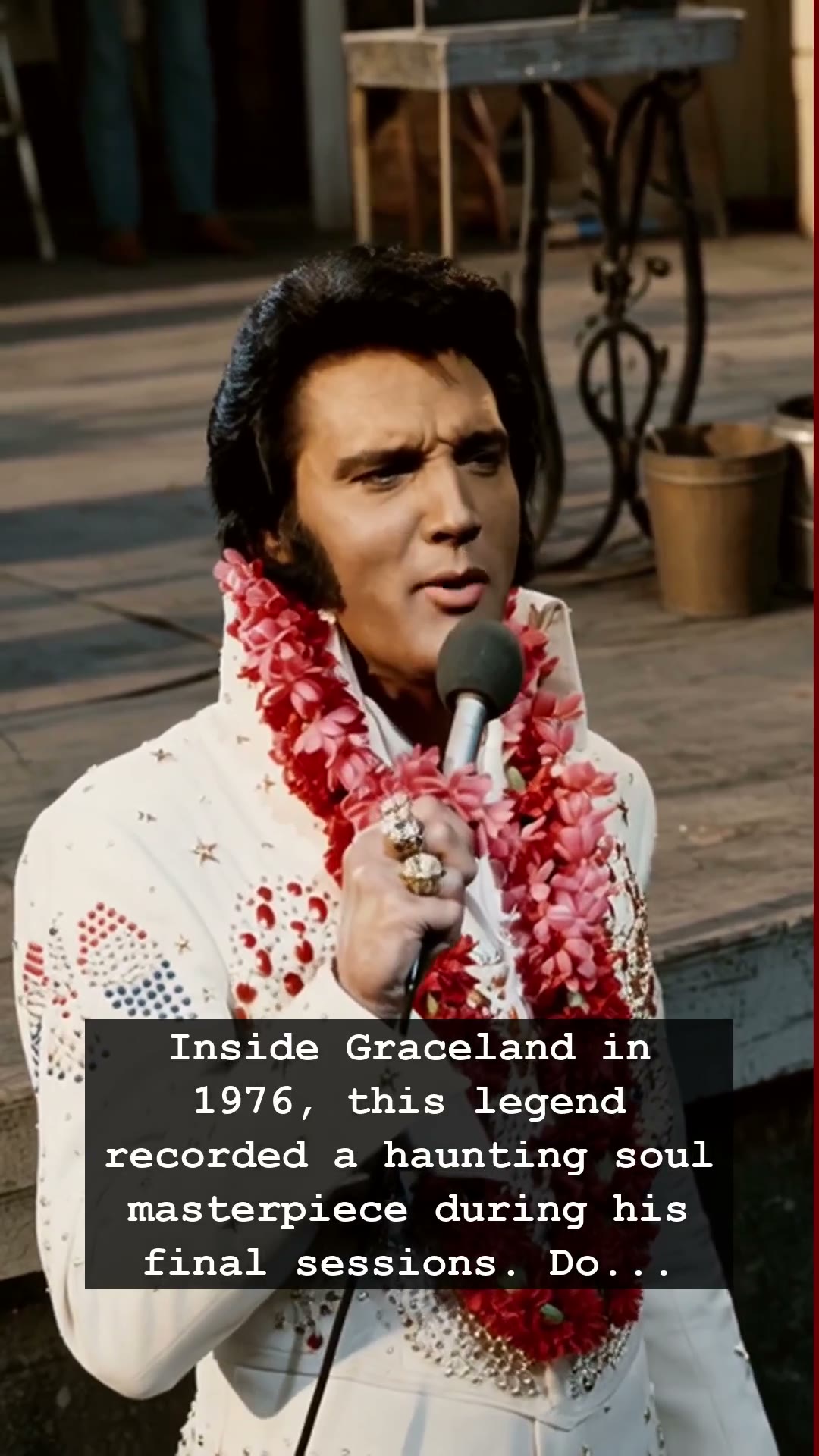
The year was 1976, and the humid air inside Graceland felt heavier than usual. Elvis Presley, the man who once ignited the world with the hip-shaking frenzy of early Rock ‘n’ Roll, was a shadow of his former golden self. Behind the closed doors of his private Jungle Room, the King of Rock was not searching for another chart-topping anthem to satisfy the record labels. Instead, he was hunting for redemption. It was here, amidst the lush greenery and the isolation of his sanctuary, that Elvis Presley poured his waning energy into what would become some of his most haunting, soul-baring recordings. The world outside was changing rapidly; the disco era was heating up at Studio 54, and the raw, dangerous energy of the fifties felt like a lifetime ago. Yet, for Elvis, the studio was a time machine.
There is a profound sadness that lingers in the songs recorded during these final months. When Elvis Presley approached the microphone, he wasn’t just performing; he was exorcising the demons of fame, failed relationships, and the relentless pressure of a career that had swallowed his youth. The songs from these 1976 sessions, such as the poignant rendition of Hurt, showcase a voice that had deepened into a rich, weary instrument of pure emotion. You can hear the cracks in his armor, the exhaustion of a man who had lived ten lifetimes in the spotlight. It was a stark contrast to the slick, overproduced hits dominating the radio waves of the mid-seventies, offering instead a raw, unfiltered look at a legend nearing his twilight.
To understand the gravity of these sessions, one must look at the atmosphere within Graceland. This wasn’t a sterile recording studio in Los Angeles; it was his home, his fortress, and his cage. The shag carpets and tiki motifs of the Jungle Room provided a bizarre backdrop for what would become a haunting musical swan song. Elvis Presley would often work in the dead of night, surrounded by his inner circle, chasing a feeling rather than a perfect take. These sessions were the final instances where the King had total control, stripped of the glittering costumes and the blinding stage lights, leaving only the man behind the myth.
Why do these final notes still resonate with us nearly fifty years later? Perhaps it is because we recognize the vulnerability in his delivery. We all carry our own versions of heartbreak, and when Elvis Presley sings, he makes us feel less alone in our own struggles. Even as the culture moved toward the synthetic sounds of the late seventies, these recordings remained grounded in the visceral truth of human pain. It is a reminder that even the greatest icons are eventually brought to their knees by the weight of their own legacy.
Looking back at 1976, we see a snapshot of a cultural titan wrestling with his humanity. Elvis Presley left us with a legacy of sound that transcended his hits, leaving behind these intimate echoes from Graceland. As the needle drops on these tracks today, do you still feel the ghost of the King reaching out through the melody?