
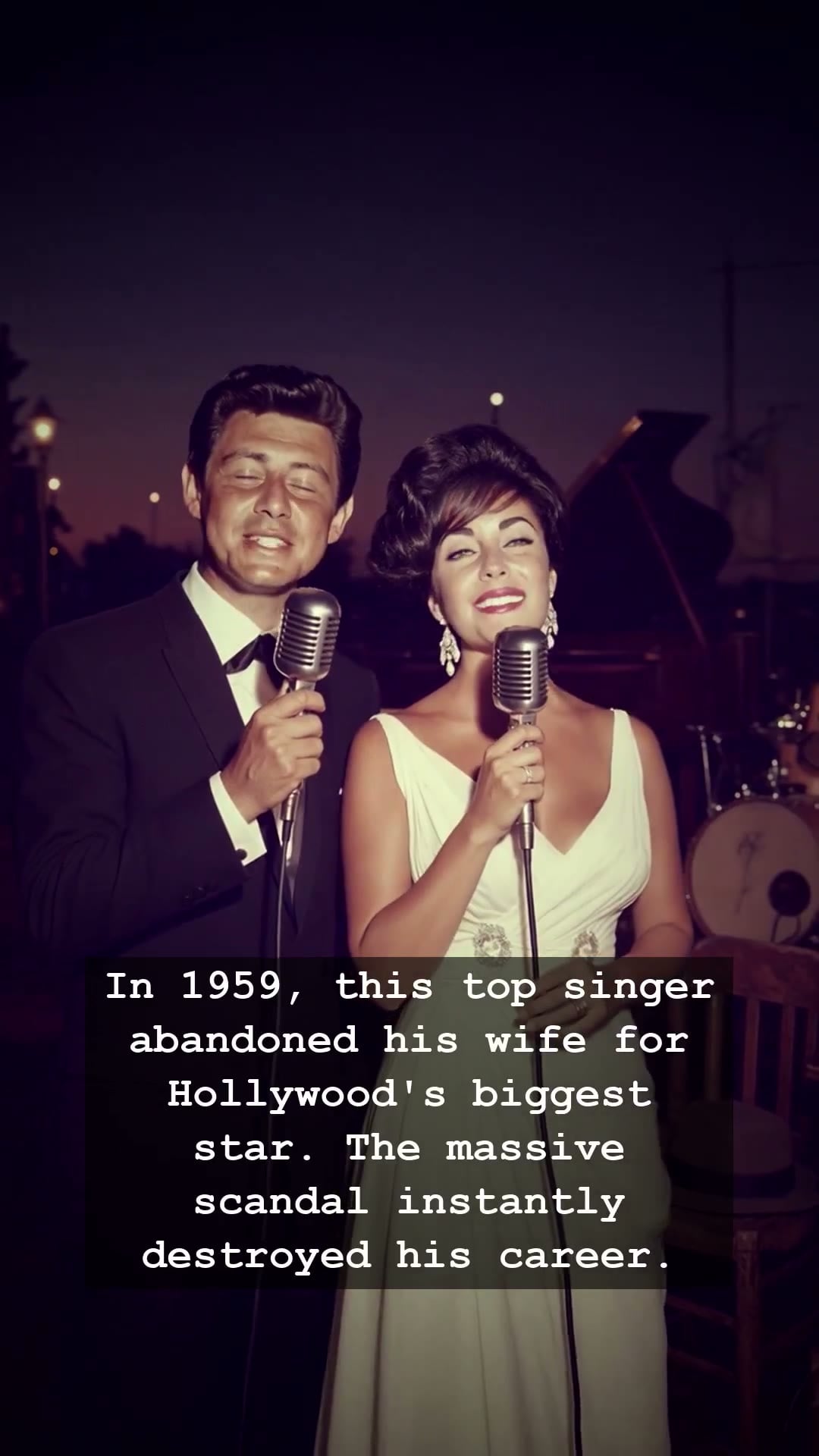
In the golden era of the 1950s, Eddie Fisher was the undisputed prince of American pop. With a voice as smooth as velvet and a clean-cut image that graced every jukebox from New York to Los Angeles, he was the idol every teenager swooned over and every parent trusted. Yet, behind the bright lights and the polished melodies, a storm was brewing. In 1959, Eddie Fisher made a choice that would not only rewrite the headlines of the century but also effectively silence his singing career, proving that in Hollywood, a single scandalous move can burn an empire to the ground overnight.
The trigger for this downward spiral was his sudden, reckless decision to leave his wife, the beloved America’s sweetheart Debbie Reynolds, for the most glamorous woman on the planet: Elizabeth Taylor. At the time, Elizabeth Taylor was not just a screen siren; she was royalty, a titan of the silver screen grieving the tragic loss of her husband, Mike Todd. When Eddie Fisher stepped in to offer his condolences and eventually his hand in marriage, the American public felt betrayed. The narrative shifted instantly from a romantic tragedy to a sordid tale of infidelity and betrayal that captivated the nation, overshadowing the very music that had once made Eddie Fisher a household name.
It is difficult to overstate the magnitude of the backlash. This was an era before the internet, yet the scandal moved with the speed of a wildfire through newspapers and radio airwaves. The moral judgment from the public was swift and unforgiving. As the couple’s relationship became the fodder for every tabloid in the country, the once-golden Eddie Fisher found himself blacklisted by the same radio stations that used to keep his records on heavy rotation. He was no longer the charming boy next door; he was the man who broke America’s heart. The music industry, ever sensitive to public perception, pushed him aside, and the record deals that once seemed endless began to evaporate into thin air.
Looking back, the story of Eddie Fisher and Elizabeth Taylor serves as a haunting reminder of the fragile contract between an artist and their audience. They were icons of a transitionary decade, caught between the wholesome post-war aesthetic and the rising tide of celebrity obsession that would come to define the later years of the 20th century. While he continued to record and perform, the magic was never quite the same. The public had cast their vote, and his career never fully recovered from the stigma of that infamous 1959 wedding. His voice, once the heartbeat of the charts, became a footnote in the grand, dramatic tapestry of Hollywood history.
Today, we often romanticize the music of the 50s as a simpler time, yet stories like this prove that the underbelly of fame has always been treacherous. The demise of Eddie Fisher at the height of his powers remains a classic cautionary tale about the cost of chasing desire at the expense of one’s reputation. Whenever we hear his old hits crackling on a vintage record player, we are reminded of a man who traded his crown for a queen, only to lose his kingdom in the process. It is a timeless, bittersweet melody of lost love and the relentless, unforgiving glare of the public spotlight.