
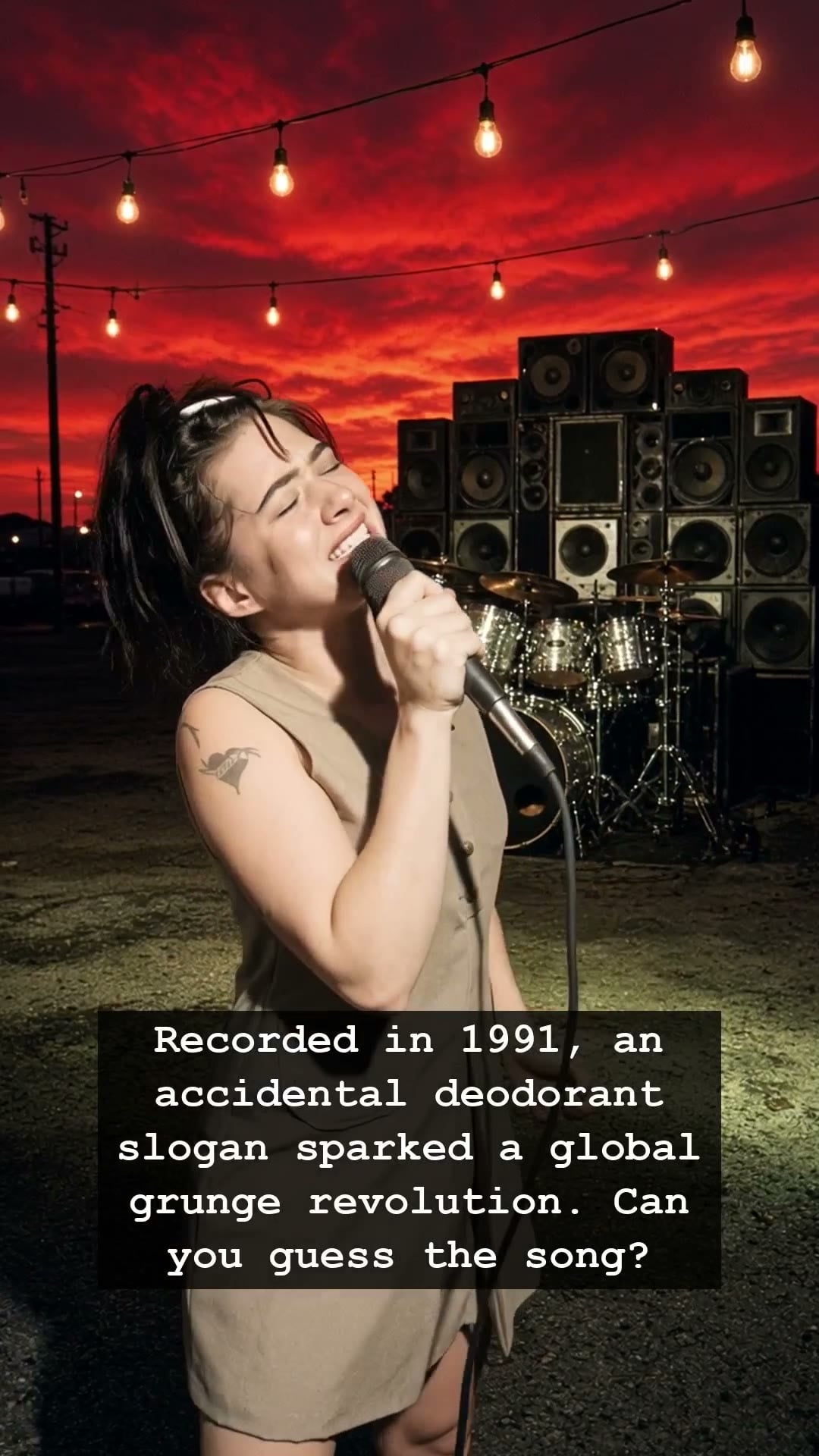
It started with a casual scribble on a bedroom wall, a drunken joke between friends that would soon become the anthem for an entire disillusioned generation. In 1991, while the radio waves were still crowded with the polished synthesizers of the eighties and the excess of hair metal, a scruffy trio from the Pacific Northwest walked into a studio with little more than raw angst and battered instruments. They had no idea they were about to tear down the walls of the industry. The song was Smells Like Teen Spirit, and its origin was as accidental as the revolution it sparked.
The phrase itself was nothing more than a deodorant slogan captured in a moment of absurdity. Kathleen Hanna of the punk band Bikini Kill had scrawled Smells Like Teen Spirit on Kurt Cobain’s wall, jokingly mocking his perceived scent. To anyone else, it was just a throwaway comment, but to Kurt Cobain, it held a poetic, rebellious gravity. When he arrived at Sound City Studios to record the follow-up to their debut, the band was starving, broke, and entirely uninterested in playing the game of corporate rock. They were the voice of the outsiders, and the song they birthed that day would soon terrify record executives who didn’t understand the tidal wave of sound they were witnessing.
When Smells Like Teen Spirit hit the airwaves, the cultural landscape shifted overnight. Suddenly, the neon aesthetics of the decade prior felt hollow. The world was being introduced to the raw, unpolished grit of the Seattle grunge scene. Kurt Cobain became an unwilling messiah, a man whose haunting lyrics and feedback-drenched guitar lines captured the existential exhaustion of Gen X. The music video, featuring a chaotic, disintegrating high school pep rally, became a staple on MTV, broadcasting a sense of glorious, nihilistic catharsis to millions of living rooms. It was the sound of a generation realizing that they didn’t have to be perfect; they just had to be heard.
Beyond the wall of sound and the screaming vocals, there was a profound, aching vulnerability in Kurt Cobain that resonated deeply with his listeners. He spoke for the outcasts, the misfits, and those who felt alienated by the glossy veneer of late twentieth-century pop culture. Behind the scenes, however, the pressure of fame began to eat away at the band. The rapid transition from underground dive bars to the massive stages of international arenas was a weight that Kurt Cobain struggled to carry. The fame was a cage, and the music was his only way to communicate the darkness he kept hidden from the spotlight.
Decades later, the legacy of Smells Like Teen Spirit remains untouched by time. It continues to be a sonic time machine, transporting us back to an era when music was still dangerous, unpredictable, and fiercely authentic. We still remember where we were when we first heard that opening guitar riff, a sound that signaled the end of one era and the violent, beautiful birth of another. As we look back, we see that Kurt Cobain didn’t just write a hit song; he gave a voice to the voiceless, leaving behind a permanent mark on the history of rock and roll. Can you still feel the static on the radio when those first notes hit?