
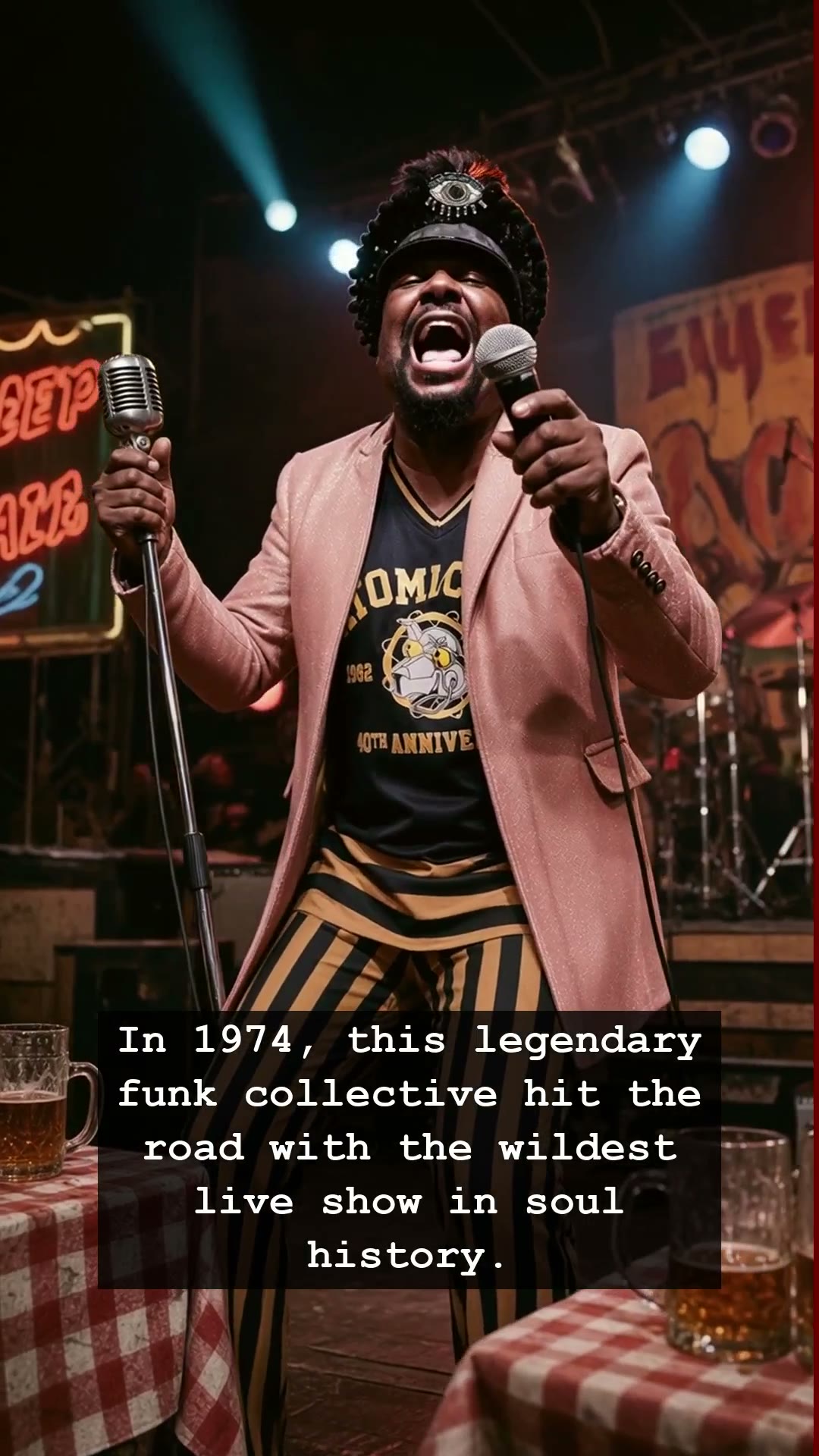
It was 1974, a year when the airwaves were still vibrating with the dying embers of the psychedelic era and the neon pulse of disco was just beginning to take hold. Into this landscape stepped George Clinton, a man who didn’t just play music; he orchestrated a cosmic intervention. Imagine standing in a packed arena, the lights dimming to a deep, interstellar purple, and suddenly, a massive, chrome-plated spacecraft begins to descend from the rafters. This was not a dream, and it was certainly not your average soul concert. It was the birth of the P-Funk Mothership, the most outlandish, theatrical, and brilliantly chaotic live experience in the history of American music.
George Clinton had a vision that transcended the standard Motown polish. He wanted to fuse the guttural, heavy grooves of funk with a science-fiction mythology that felt like a fever dream. When the collective—Parliament-Funkadelic—hit the road, they brought with them a circus of absurdity. There were outlandish costumes, heavy-duty bass lines that shook the very foundations of the venue, and a commitment to funk that bordered on the religious. For a generation of music lovers who felt disenfranchised by the corporate-leaning rock of the mid-seventies, George Clinton offered a sanctuary of absolute, unadulterated freedom.
Behind the scenes, the story was far more complex than the vibrant, colorful stage lights suggested. The life of a touring musician in the seventies was fraught with the weight of constant motion and the heavy toll of fame. George Clinton managed an enormous, rotating cast of geniuses, many of whom were battling their own demons while trying to maintain the tight, rhythmic precision that defined their sound. The tension between the incredible musical output and the sheer instability of the band’s inner workings created a volatile alchemy, resulting in music that felt dangerous, raw, and entirely authentic. It was the sound of people pushing the boundaries of what was possible in a studio.
The impact of these shows went beyond just the music; they became a cultural touchstone. In an era before the digital saturation of MTV, if you wanted to see the Mothership, you had to be there. The memory of that heavy, thumping bass line vibrating through your chest remains etched in the minds of those lucky enough to have witnessed it. George Clinton didn’t just perform; he led a revolution of the groove, transforming the concert hall into a communal ritual where the barriers between the stage and the audience were obliterated by pure, rhythmic intensity.
Decades later, the legacy of George Clinton remains undeniable. From the rise of hip-hop, which sampled his tracks to provide the backbone for a new generation of sound, to the continued appreciation of classic funk, his fingerprints are everywhere. When we look back at that 1974 tour, we aren’t just remembering a stage prop or a musical style; we are remembering a moment when music felt truly limitless. Do you still remember the first time you heard the Mothership landing? The groove never truly left us, and perhaps, in our own way, we are all still waiting for the next beat to drop.