
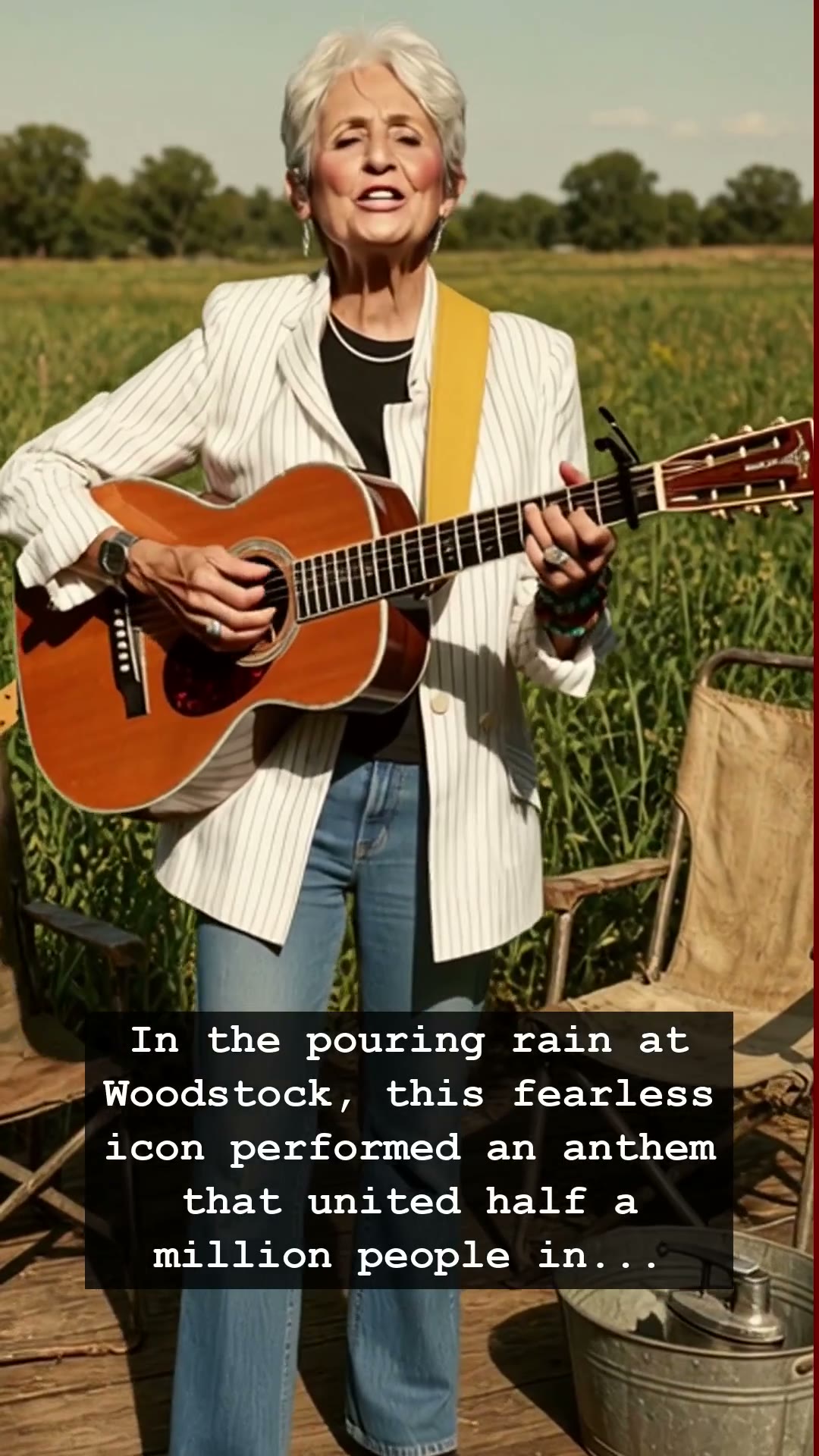
The rain did not just fall on Bethel, New York, in August 1969; it hammered down on a generation’s conscience. As a literal sea of humanity stood knee-deep in the churned-up mud of Max Yasgur’s farm, the atmosphere was thick with tension and the frantic uncertainty of a movement pushed to its breaking point. Into this volatile landscape stepped a figure who looked less like a rock star and more like a weary messenger of peace. Joan Baez, six months pregnant and draped in simplicity, stood before half a million souls. With no gimmicks and no overblown production, she raised her voice, and in that singular moment, the chaos of Woodstock seemed to hold its breath.
Joan Baez had always been the conscience of the folk movement, but at Woodstock, she became something more. She became the heartbeat of a counterculture that was desperately searching for unity amidst the rising tides of the Vietnam War and deep-seated social unrest. As she began to sing, the damp, shivering crowd found a strange, communal warmth. Her performance of We Shall Overcome was not merely a song; it was a prayer whispered into the roar of a changing world. It remains one of the most hauntingly beautiful images of the 1960s, a testament to how one artist could command a massive, restless audience through nothing but raw sincerity and a spine-chilling soprano.
The drama of that weekend was not limited to the music. Behind the scenes, the festival was a logistical nightmare on the verge of total collapse. Yet, as Joan Baez delivered her set, the politics and the misery of the mud were temporarily suspended. Her presence provided the necessary gravitas that balanced the psychedelic fervor of the other acts. While others relied on electric distortion to mirror the intensity of the era, Joan Baez relied on the purity of her convictions. She carried the weight of a movement that was trying to define itself, and in the process, she solidified her legacy as an indispensable pillar of the American musical tapestry.
Decades later, the echo of that performance still resonates for those who lived through the transformative years of the late sixties. We look back at the era of the jukebox and the communal spirit of Woodstock with a sense of profound nostalgia, wondering if we will ever see such raw, unvarnished human connection again. Joan Baez served as the bridge between the old guard of protest music and the new dawn of a disillusioned generation. Her courage to stand on that stage, exposed to the elements and the intense scrutiny of a nation, proved that art is most powerful when it is at its most vulnerable.
Even now, as we reflect on the cultural tremors of 1969, Joan Baez stands as a reminder that the loudest voice isn’t always the one that screams the loudest. Sometimes, it is the one that stays steady in the pouring rain. As the mud of Woodstock fades into history, the story of that night remains a golden thread in the story of music. Do you still remember the feeling of that anthem rising through the mist, or have the decades turned that fire into mere legend?