
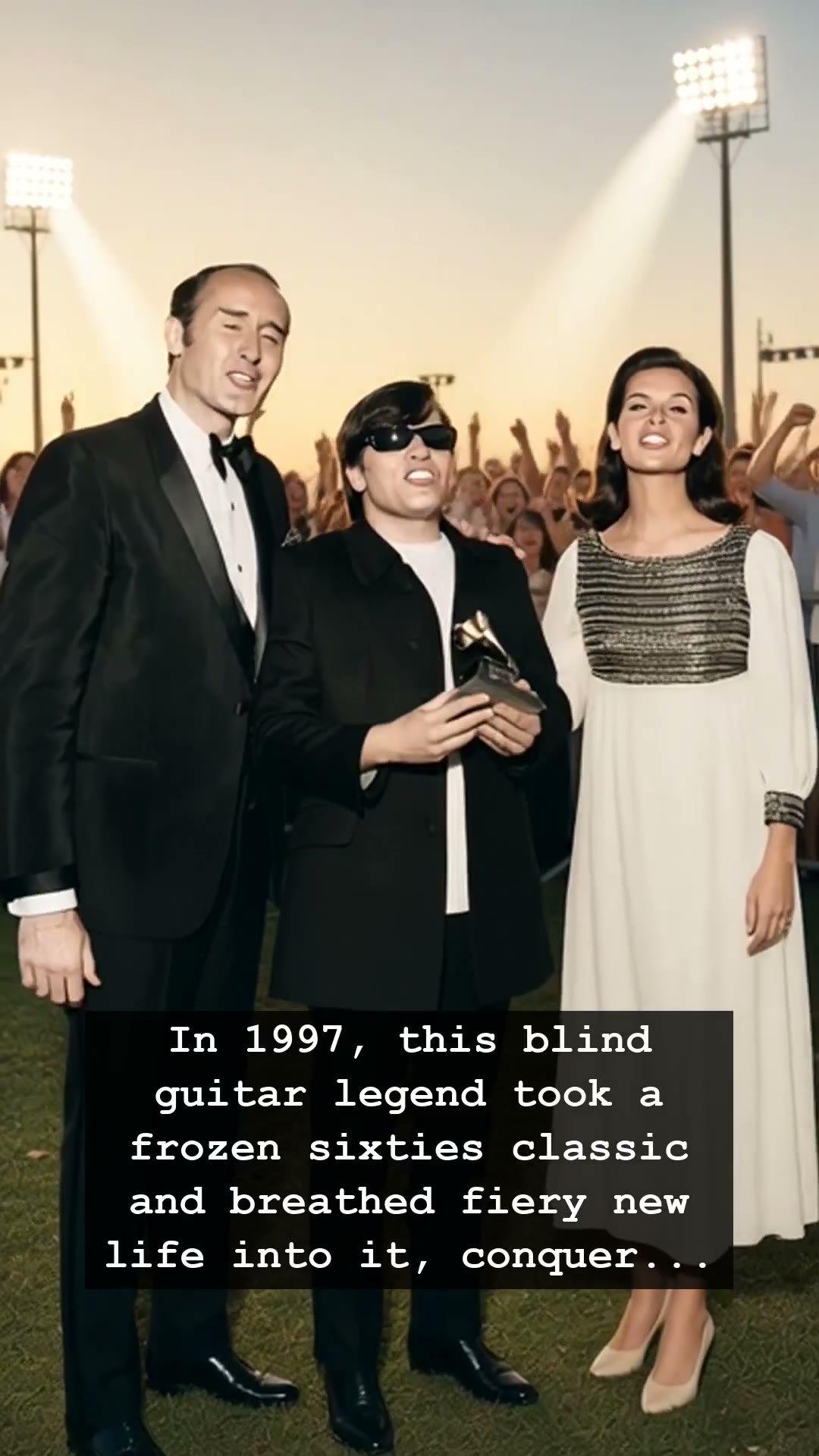
The year was 1968, and the airwaves were crowded with the psychedelic fog of the Summer of Love. Rock music was being redefined, and The Doors had already staked their claim on the charts with the smoldering, enigmatic anthem Light My Fire. But then, a blind guitarist from Puerto Rico named Jose Feliciano arrived with an acoustic guitar and a soul-deep vulnerability that nobody saw coming. He did the unthinkable: he took a song that defined the edgy, dark ego of Jim Morrison and completely dismantled it, only to rebuild it as a bossa nova-infused heartbreak. When Jose Feliciano struck those first nylon-string chords, the music industry braced for a disaster, but instead, they witnessed a musical resurrection that felt as fresh as a desert dawn.
To understand the magnitude of this shift, you have to remember the era. This was a time when studio production was becoming increasingly experimental, layering tracks with heavy reverb and electric distortion. In the middle of this electronic whirlwind, Jose Feliciano stood alone, his dark glasses masking eyes that had never seen the light of day, yet seeing music with a clarity that escaped his contemporaries. His version of Light My Fire was not just a cover; it was an act of artistic defiance. He stripped away the theatrical menace of the original and replaced it with a rhythmic, percussive warmth that forced listeners to stop in their tracks. It was a moment of pure, unadulterated talent cutting through the clutter of the late sixties.
The impact was seismic. By 1968, Jose Feliciano had not only shocked the rock world but also found himself standing at the center of a cultural firestorm. Critics were divided, purists were bewildered, but the public heard something transcendent. He transformed a psychedelic trip into a universal cry of desire. It was the kind of bold move that usually marks the end of a career, but for him, it was only the beginning. He proved that you do not need an arena full of Marshall stacks to dominate the airwaves—you just need a story and the skill to tell it with your bare hands on a wooden fretboard.
Decades later, the legend of that recording persists. In the late nineties, when that same fiery rendition found its way back onto modern radio, it sounded just as hauntingly beautiful as it did in the days of vinyl and Jukeboxes. The brilliance of Jose Feliciano lies in his ability to make time stand still. His influence stretched far beyond that one hit, bridging the gap between Latin soul and American folk-rock. He walked a path that was entirely his own, navigating a world that often underestimated him, all while leaving a trail of music that remains immortal.
We often look back at the sixties and seventies as a monolith of guitar gods and stadium anthems, but the real magic was always in the nuances. Jose Feliciano taught a generation that you can own a song simply by loving it differently than anyone else. Even now, when those chords ripple through a quiet room, you can hear the ghost of that moment—a blind boy from Puerto Rico standing against the giants and winning. Next time you catch the melody on the breeze, pause for a moment to remember the man who dared to relight the flame.