
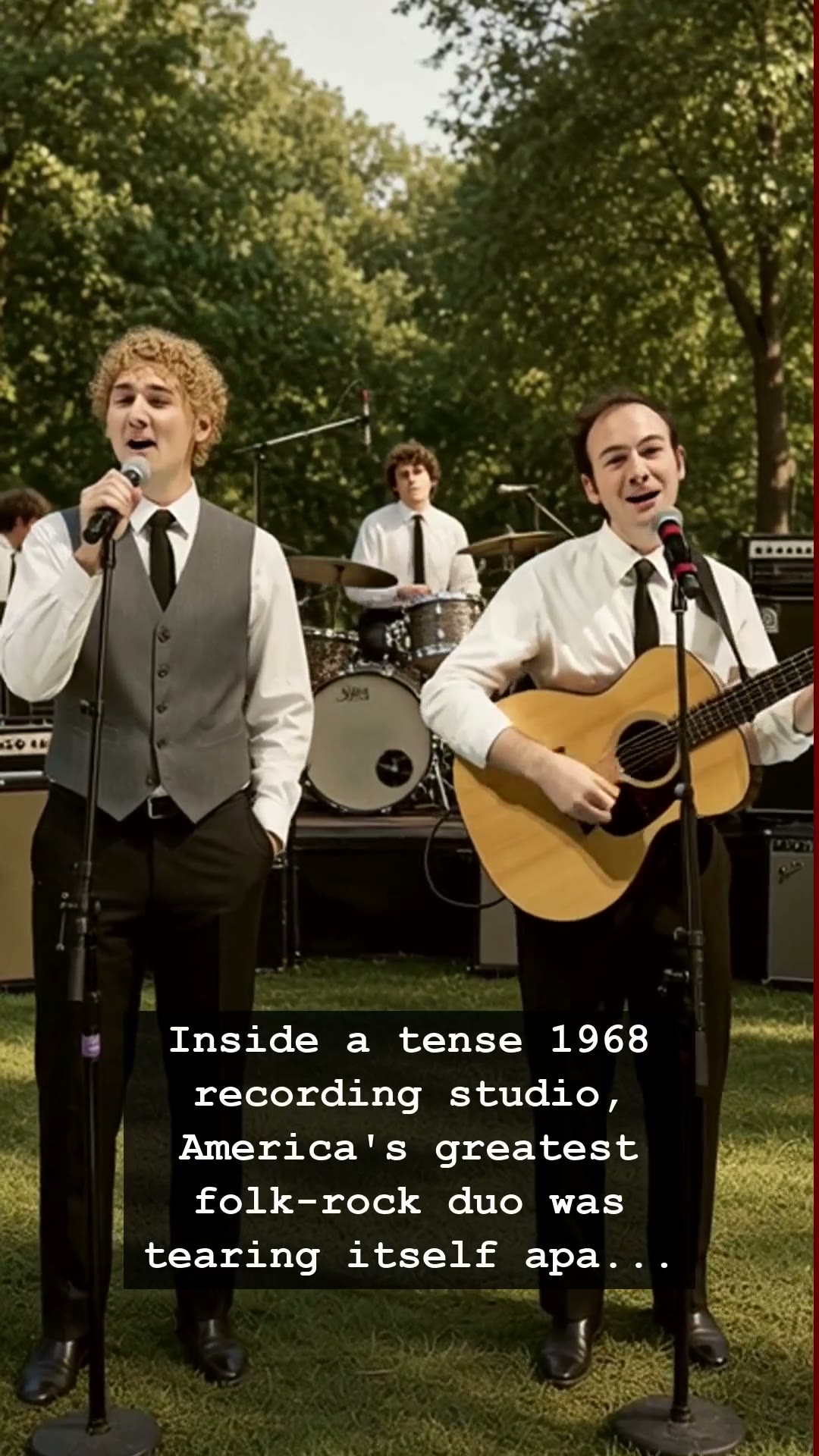
The year was 1968. While the world outside was erupting in protest, the air inside a claustrophobic New York recording studio was thick with a different kind of violence—the silent, suffocating tension between two men who once shared a childhood bond. Paul Simon and Art Garfunkel were America’s golden duo, the architects of folk-rock harmony, yet behind the polished veneer of their records, they were at absolute war. Their voices blended like silk, but their spirits were grating against one another like sandpaper. To the listener spinning their vinyl on a dusty turntable, it sounded like heavenly unity, but in reality, Simon and Garfunkel were balancing on a razor’s edge, waiting for the final, inevitable snap that would silence their magic forever.
It was not just artistic friction; it was a profound clash of identity. Paul Simon, the neurotic, perfectionist songwriter, felt his brilliance was being overshadowed by Art Garfunkel’s celestial, effortless pipes. Garfunkel, meanwhile, felt marginalized by a partner who viewed his voice as merely an instrument to serve the lyrics. As they worked on the soundtrack for The Graduate, the atmosphere became electric with resentment. Every take was a battleground. They were capturing lightning in a bottle, yet that same lightning was slowly incinerating the foundation of their friendship. It was a classic tale of creative genius curdling into bitter professional rivalry.
Yet, tucked away in the shadows of the studio, a brilliant mastermind worked to keep the fraying threads from snapping. The producer Roy Halee acted as the reluctant mediator, a sonic alchemist who understood that the tension, however destructive, was actually fueling the emotional depth of their tracks. He manipulated the acoustics of the room and the timing of their sessions to coax out performances that were arguably their most vulnerable. He knew that the very thing tearing Simon and Garfunkel apart was precisely what made their music resonate with a generation caught between the idealism of the early sixties and the encroaching disillusionment of the post-Woodstock era.
This era, marked by the crackle of the Jukebox and the intimacy of early FM radio, gave their music a specific, haunting resonance. When we listen to their records today, we aren’t just hearing harmonies; we are hearing the sound of a fractured relationship masquerading as eternal unity. The beauty of their sound was the product of a war, a paradoxical masterpiece born from the wreckage of two egos struggling for space. It is this haunting duality that keeps their legacy alive, reminding us that some of the greatest art is forged in the fires of personal agony.
Even now, decades after the final breakup that left fans heartbroken, the music of Simon and Garfunkel serves as a time capsule for an era defined by brilliance and instability. Their story is a visceral reminder that the songs which define our lives often come with a heavy, human cost. We listen to them not just for the melody, but for the ghost of the men they used to be before fame and friction pulled them into different orbits. Do you remember the first time those voices wove together for you?