
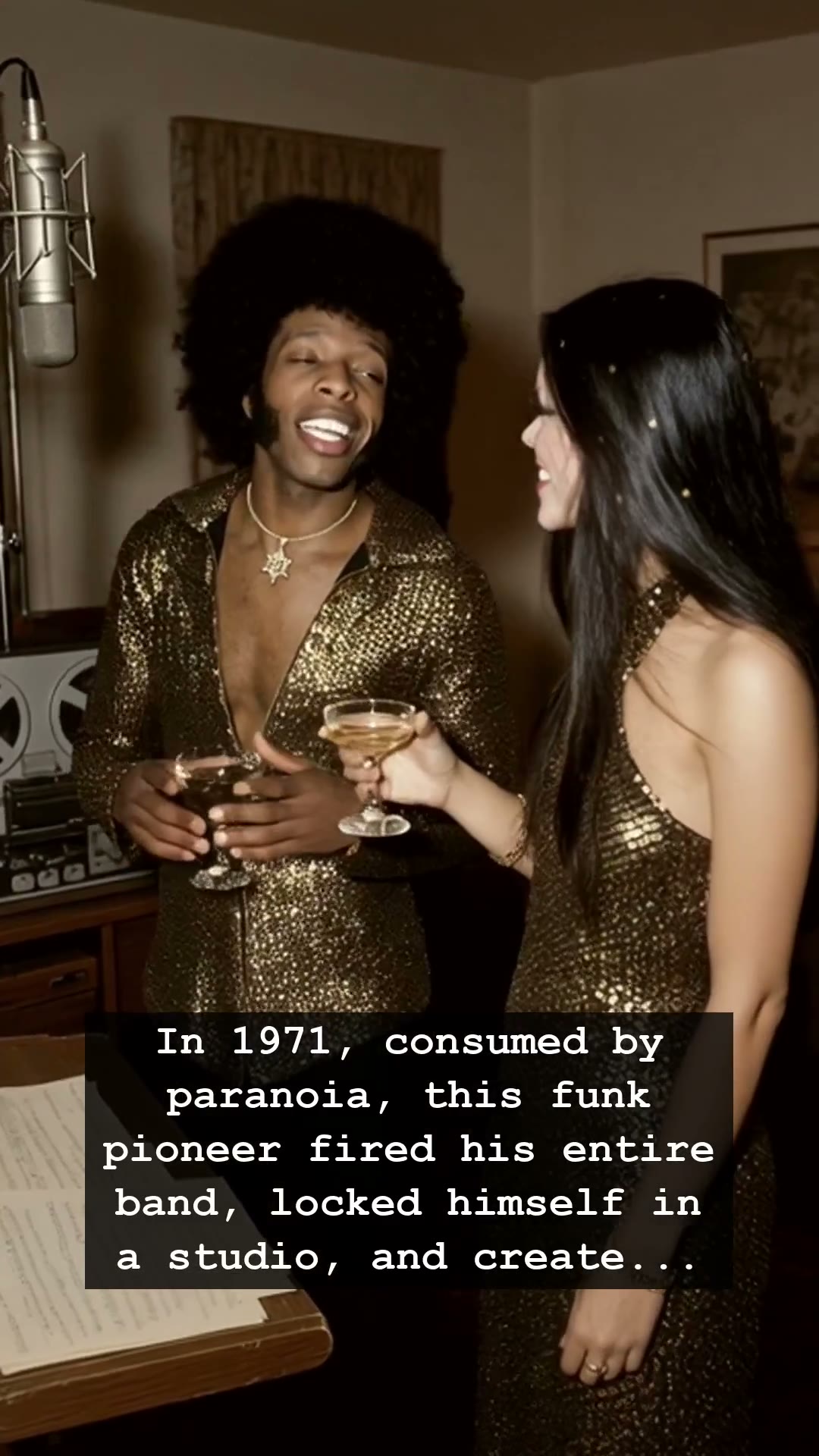
In the golden era of the early 1970s, while the world was still vibrating from the collective idealism of Woodstock, one man was descending into a private, neon-lit nightmare. Sly Stone, the visionary architect of funk, had once united the masses with a message of peace and psychedelic soul. Yet, by 1971, the face of the revolution had retreated into the shadows. Consumed by a crippling paranoia that gripped him like a vice, Sly Stone made an unthinkable decision: he fired his legendary band, Sly and the Family Stone, and retreated into the claustrophobic confines of a dark recording studio. He was no longer just a musician; he was a man at war with his own legacy.
The studio became his fortress and his prison. As the era of the high-octane live ensemble began to wane, Sly Stone turned to a cold, rhythmic pulse that would change the trajectory of American music forever. He wasn’t relying on the harmonious interplay of his brothers and sisters anymore; instead, he embraced a primitive drum machine, letting its mechanical heartbeat guide his fractured psyche. It was a radical departure, a lonely, industrial sound that felt like the precursor to the synthetic future. From this isolation, he crafted the album There’s a Riot Goin’ On, a record that replaced the bright optimism of the sixties with a murky, brooding, and intensely hypnotic aesthetic.
To listen to those tracks today is to step back into a haze of smoke-filled basements and the velvet-lined decadence of an era beginning to fray at the edges. Sly Stone was pioneering a sound that felt dangerous and detached. While his contemporaries were still chasing the sun-drenched melodies of the previous decade, Sly Stone was experimenting with the texture of shadows. The production was dense, layered with a claustrophobic brilliance that somehow managed to top the charts, proving that audiences were ready for the shift from collective joy to individual complexity. It was the birth of the funk-as-an-attitude, a gritty, unfiltered exploration of fame’s darker side.
The tragedy of Sly Stone is that his greatest creative triumph was born from his most profound breakdown. The paranoia that forced him to lock the studio door also gave him the clarity to strip away the excess of his earlier hits. He traded the vibrant horn sections and communal chants for a singular, brooding focus that resonates with anyone who has ever felt the weight of expectation crushing their spirit. It is a haunting reminder that in the music industry, the line between genius and total collapse is often razor-thin, marked by the lonely ticking of a drum machine in the dead of night.
Even now, decades after the vinyl stopped spinning on turntables across the country, the legacy of Sly Stone remains a pillar of American culture. His work stands as a testament to the fact that sometimes, when the world feels like it is burning, the most honest response is to lock the door and let the music speak for the ghosts left behind. Do you remember where you were when you first heard that low, thumping groove? Perhaps it is time to turn down the lights, press play, and revisit the genius of a man who found his revolution in the silence of his own mind.