
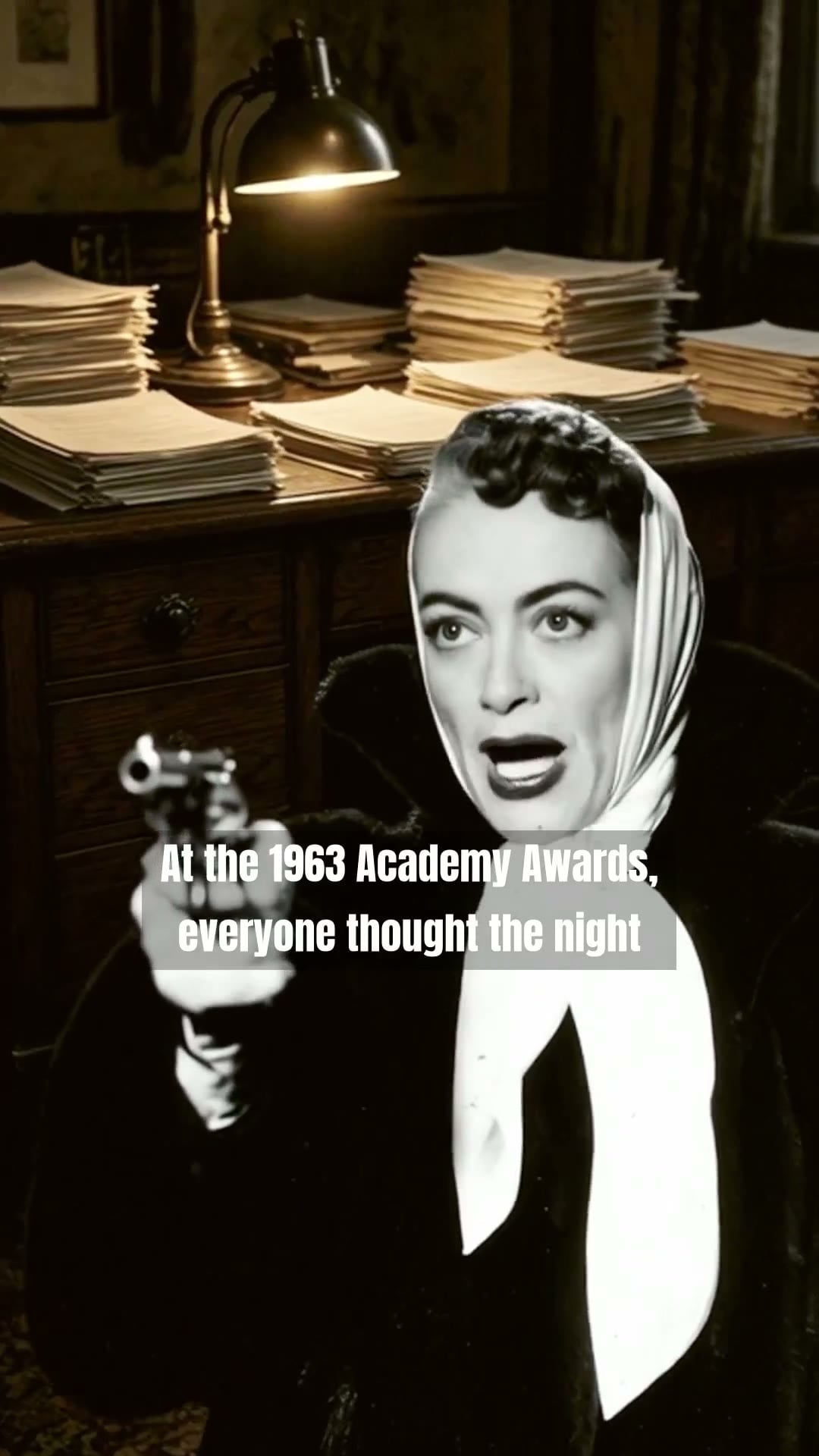
The golden age of Hollywood was built on glamour, raw talent, and the occasional calculated theater that only the true icons could pull off. Among those who understood the art of the spotlight better than anyone was Joan Crawford. While her career spanned decades of cinematic evolution, from the silent era through the grit of the fifties and into the psychological thrillers of the sixties, it was the 35th Academy Awards in 1963 that remains etched in our collective memory. It was a night where Joan Crawford proved that even when not nominated, she could command the entire industry’s attention with a single, brilliant move.
At the time, the air in the Santa Monica Civic Auditorium was electric. The crowd was waiting to see who would claim the coveted statue for Best Actress, a category that featured fierce competition. Joan Crawford, ever the professional and the master of her own public image, found herself at the center of the night’s most discussed moment. By accepting the award on behalf of her absent co-star, Anne Bancroft, Joan Crawford did more than just fill a vacancy on the stage; she created a legend. In that era of Method Acting and intense studio rivalries, her decision to step into the limelight was widely seen as a calculated masterstroke that defined her reputation as a force to be reckoned with.
Looking back, this moment tells us so much about the stature of actors during that period. Joan Crawford represented a generation of stars who knew exactly how to navigate the machinery of fame. Before the digital age, when news traveled via the morning papers and word-of-mouth, these stars were larger than life. They were the architects of their own myths, carefully curating their presence at every premiere and Oscar night. Joan Crawford held an unwavering belief in her own significance, a quality that kept her relevant long after her contemporaries began to fade from the silver screen.
It is easy to focus on the technicalities of the drama, but for those of us who grew up watching her films on VHS or catching glimpses of her legacy on the Walk of Fame, there is something profoundly human in her ambition. She was a woman who fought for every inch of her career in an industry that was rarely kind to aging actresses. By maintaining her grip on the cultural conversation, she ensured that her influence would persist for generations. Her story is not just about the theater of awards shows; it is about the resilience of a woman who refused to be relegated to the background.
Today, we look back at the career of Joan Crawford not just for the roles she played, but for the indelible mark she left on the soul of Hollywood. Her life was a long, complex performance that commanded respect even from her harshest critics. As we revisit the films that defined the mid-century era, we are reminded that true icons never really leave the screen; they simply wait for us to press play once more. Her legacy remains a vital, shimmering thread in the tapestry of American cinema, inviting us to remember a time when Hollywood was truly, undeniably grand.