
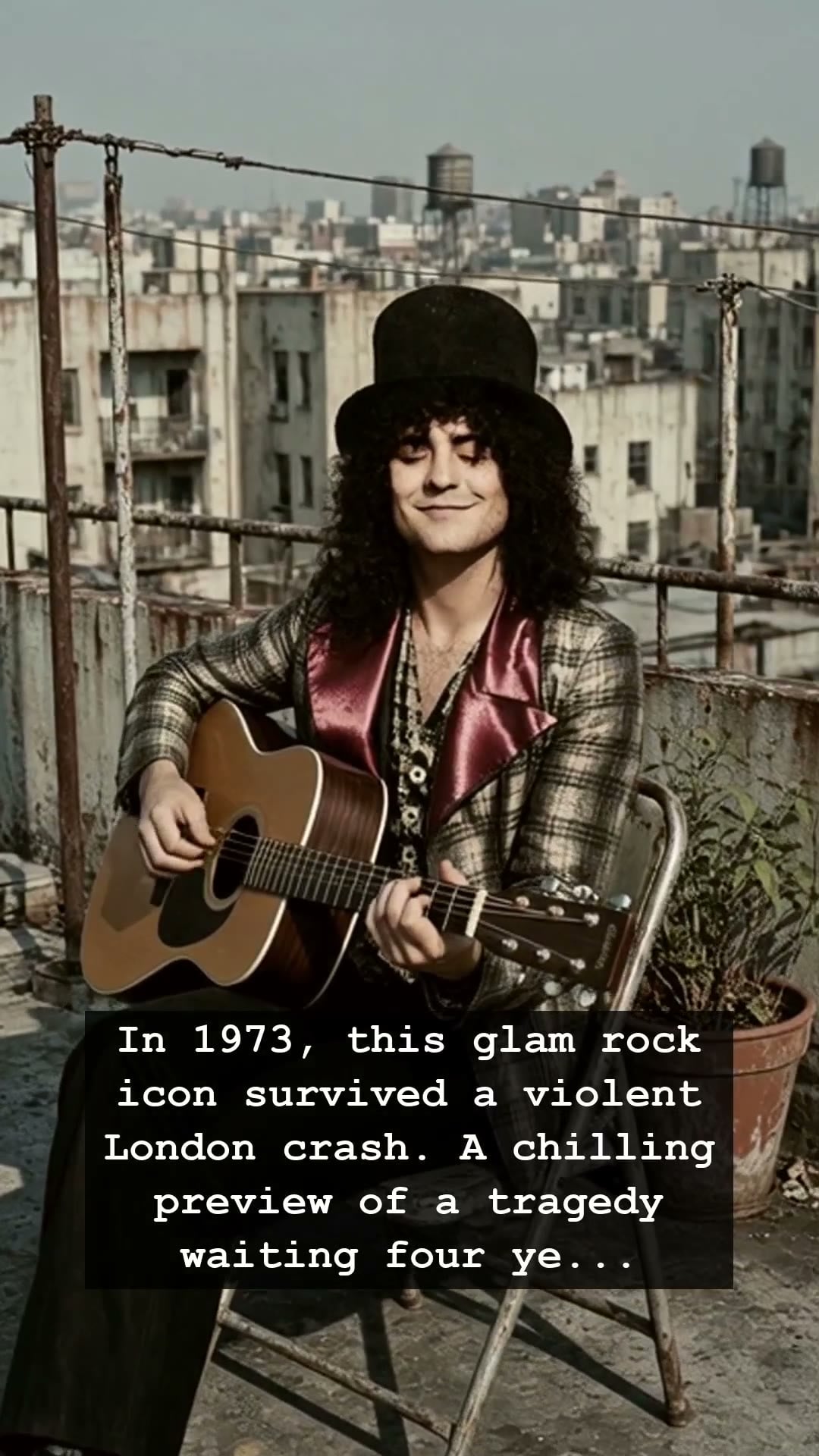
In the glitter-dusted landscape of early 1970s Britain, Marc Bolan was more than just a musician; he was an otherworldly messiah of Glam Rock. With his velvet suits, sparkling face glitter, and a guitar sound that felt like it had been plucked from a star-studded dimension, he defined an era. Yet, behind the shimmer of T. Rex and the hypnotic pulse of the Top of the Pops stage, a dark shadow was creeping toward him. Few people realize that four years before his untimely death, Marc Bolan lived through a terrifying dress rehearsal for the end, a violent car crash in London that left his Mini a mangled wreck. It was a chilling, eerie moment that seemed to suggest the universe had already begun closing its curtains on one of music’s brightest pioneers.
To understand the significance of this moment, one must look at the atmosphere of the 1970s. It was a time when the Jukebox reigned supreme in smoky cafes, and the radio was the pulse of a generation. Marc Bolan had become the poster boy for a movement that prioritized spectacle and sensory overload. He moved through the world with an air of delicate fragility, a stark contrast to the gritty, heavy sounds that would eventually emerge later in the decade. That 1973 crash was more than just a bad night in a city known for its rain-slicked streets; it was a psychological turning point. Even as he walked away from the wreckage, observers noted that the invincibility he once projected had been irrevocably fractured.
Tragically, fate rarely strikes twice without a purpose. When the final accident occurred in 1977, the world lost more than just an icon; it lost a visionary who had bridged the gap between psychedelic folk and the explosive, unapologetic glam that followed. The irony was suffocating: Marc Bolan, a man who never learned to drive and had an irrational, lifelong fear of automobiles, found his destiny tied to the very machine he feared most. This dichotomy between his fame—a life lived in the spotlight of the press—and his private, quiet anxieties is what continues to haunt his legacy today.
His music remains a vibrant time capsule. Listening to a T. Rex track today is like stepping into a dream where disco balls spin eternally and the fashion is as loud as the rhythm. The tragedy of Marc Bolan is that his death stopped the music just as he was preparing for a triumphant resurgence. He was an artist in constant flux, evolving from a hippie troubadour into a rock god, and he was arguably on the cusp of an even greater transformation before the silence took hold.
Today, we look back at the life of Marc Bolan not just as a tragic cautionary tale, but as a testament to the raw, human cost of fame. He lived fast and shone with a singular, blinding intensity that rarely leaves room for a long life. As we revisit his records, spinning the vinyl on our turntables, we aren’t just hearing music; we are witnessing the ghost of a man who danced on the edge of a precipice, forever glittering in the dim light of history.