
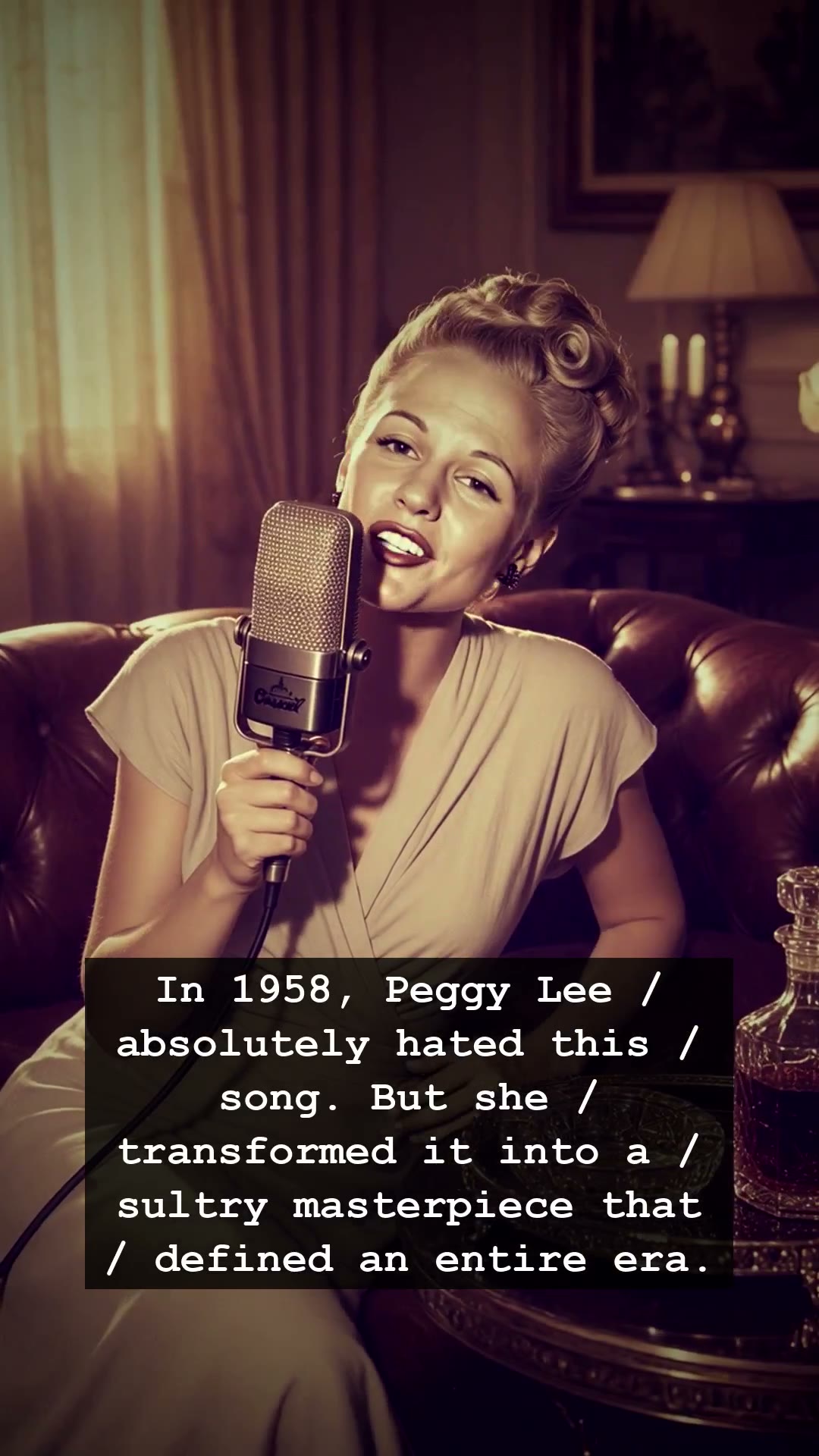
In 1958, the legendary Peggy Lee stood in a recording studio, staring at a sheet of music she felt nothing but pure disdain for. It was a song she considered trivial, almost beneath her stature as a jazz icon who had already conquered the jukebox era. Yet, she was under pressure to deliver, and the industry machine of the 1950s rarely took no for an answer. Instead of walking away, Peggy Lee did something that would alter the course of music history forever. She stripped the song to its bare bones, removing the orchestral clutter and leaving behind only a haunting, rhythmic bass line and the sharp, deliberate snap of her fingers. That track was Fever.
At the time, the studio was a place of high stakes and cigarette smoke, where the scent of ambition was as thick as the air itself. Peggy Lee had a vision that her producers simply could not grasp until the tape started rolling. By transforming a frantic, uptempo melody into a slow, sultry, and dangerous crawl, she created a soundscape that felt like a secret whispered in the dark corners of a neon-lit lounge. She didn’t just sing the words; she inhabited the soul of the song. It was a masterclass in minimalism, proving that what a performer leaves out is often just as important as what they put in.
This iconic moment captured the tension between artistic integrity and commercial demand, a struggle that defined the careers of so many mid-century performers. Before the era of MTV, before the digital revolution, and long before the pristine production of modern pop, Peggy Lee stood in that room and insisted on her own truth. Her instincts were razor-sharp. The resulting version of Fever became more than just a hit record; it became an atmospheric masterpiece that encapsulated the cool, detached elegance of late 1950s American culture.
Decades later, the resonance of that session still echoes. Every time you hear those iconic finger snaps, you are transported back to a time when vinyl was king and a single microphone could capture the depth of a human heartbeat. Peggy Lee proved that a truly great artist can take a song they detest and forge it into a signature piece that defines their entire legacy. Her cold, calculated approach to the arrangement turned a song she wanted to abandon into a permanent fixture in the Great American Songbook.
Today, we look back at the 1950s with a mix of awe and curiosity, often romanticizing the grit and the glamour of those studio sessions. Peggy Lee reminds us that behind every polished performance lies a story of friction, creative rebellion, and the sheer audacity of an artist who knows exactly what they are doing. Whether she liked the song or not, she crafted a timeless sound that remains as intoxicating now as it was the day it was recorded. Close your eyes, let the bass line take over, and imagine yourself in that room, witnessing the moment a legend was born.