
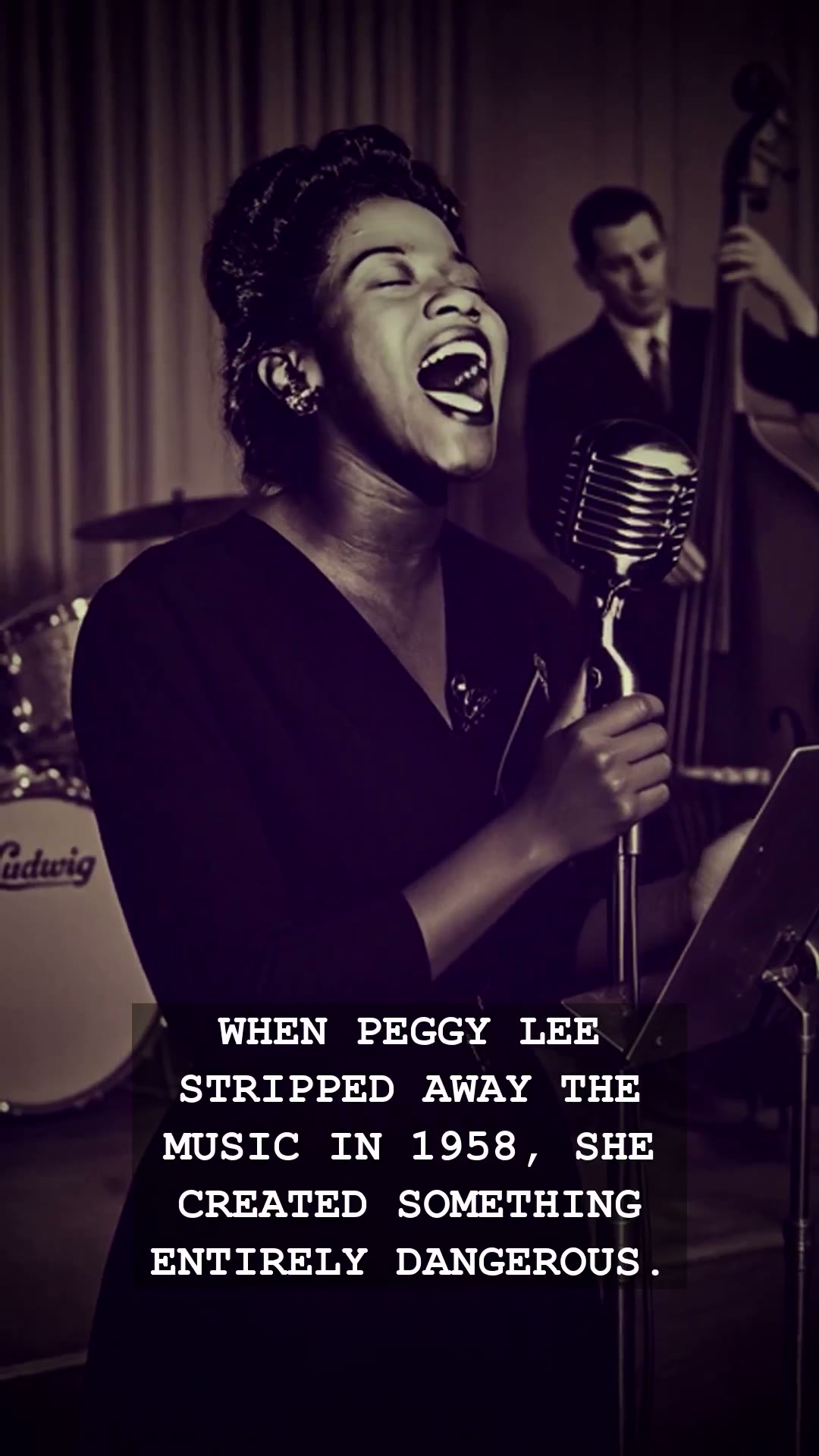
In the smoke-filled, velvet-draped lounges of the late 1950s, the world of music was undergoing a tectonic shift. While rock and roll was beginning to stir the youth into a frenzy, one woman stood center stage, defying the trend by doing almost nothing at all. In 1958, Peggy Lee did the unthinkable. She stripped away the lush, orchestral arrangements that defined the era and replaced them with the raw, rhythmic pulse of a heartbeat bass and the sharp, sudden sting of finger snaps. When Peggy Lee unleashed her version of Fever, she didn’t just record a song; she weaponized silence.
To understand the gravity of that moment, one must remember the sonic landscape of 1958. It was a time of brass-heavy swing and the early, rebellious growls of idols like Elvis. Yet, Peggy Lee chose to retreat into a dark, intimate corner. By removing the safety net of complex instrumentation, she laid her own voice bare. It was a dangerous kind of minimalism, one that forced the audience to lean in, hold their breath, and wait for the next snap. It was the birth of the ultimate cool, a sophisticated rebellion that felt far more subversive than any guitar solo could ever hope to be.
Behind the scenes, the legend of Peggy Lee was just as complex as the track itself. She was a woman of immense creative control in an industry that rarely granted it to female artists. She knew that the space between the notes was just as important as the notes themselves. This wasn’t just a hit record; it was an exercise in power. During a time when television was beginning to dominate living rooms and the jukebox was the heartbeat of every roadside diner, Peggy Lee’s Fever captured a specific kind of tension that felt both timeless and illicit. It was the sound of a private conversation held in a crowded room.
That chilling, sparse arrangement has echoed through the decades, influencing everyone from synth-pop pioneers to modern minimalist producers. It remains a masterclass in tension and release. Whenever the beat drops or the silence stretches too long in a modern track, there is a ghost of Peggy Lee haunting the recording studio. She proved that you do not need an army of instruments to dominate a room; you only need a steady rhythm and the confidence to let the silence do the work for you.
As we look back at the twilight of the fifties, it is easy to romanticize the era as one of innocence. But in truth, artists like Peggy Lee were pushing boundaries, exploring the darker, more sultry edges of the human experience through their craft. Her influence is a testament to the fact that true genius often lies in what you choose to leave out rather than what you put in. Next time you find yourself captivated by a song that feels dangerous, mysterious, and effortlessly cool, take a moment to listen for the finger snaps that started it all.