
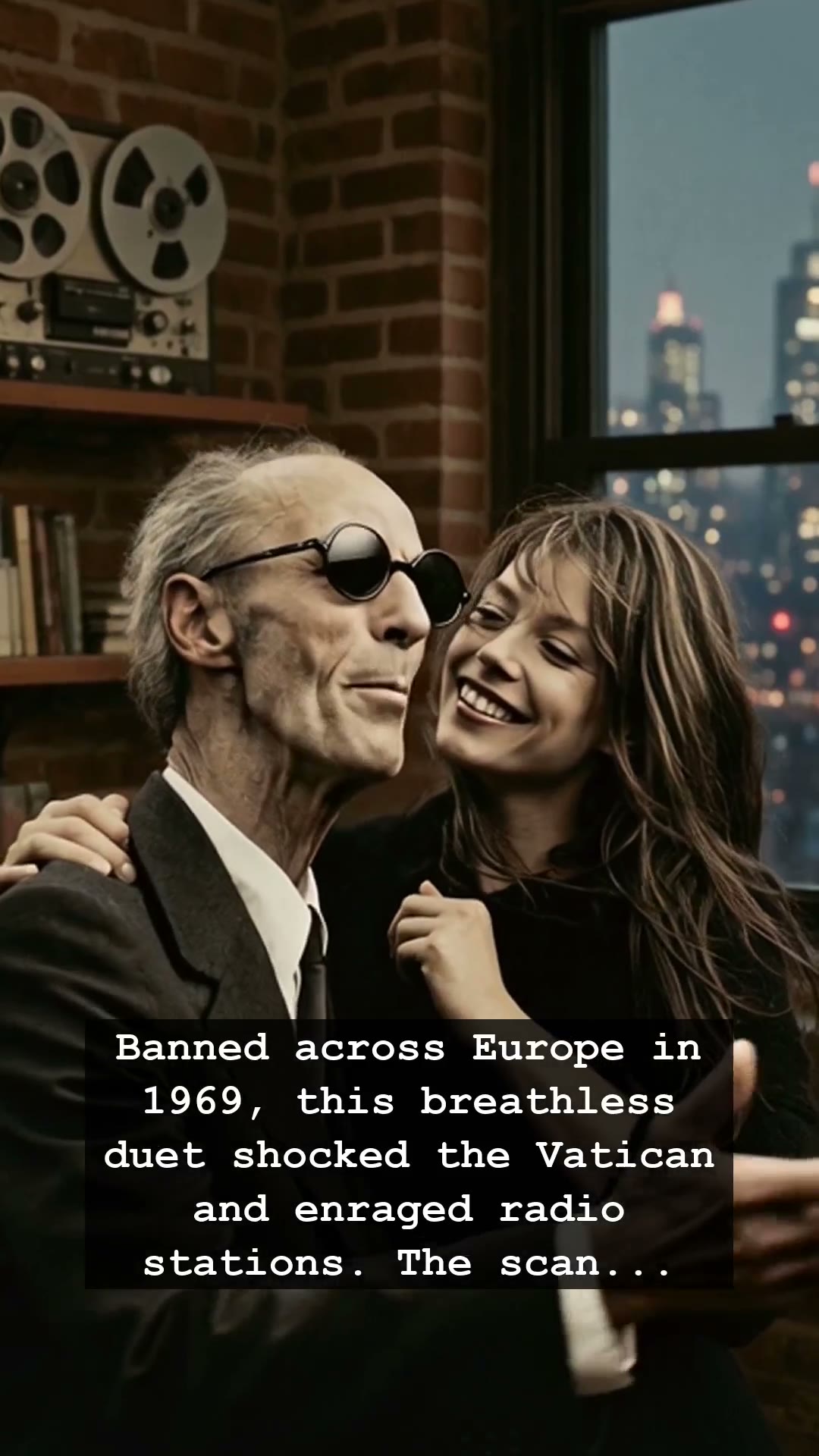
It was 1969, a year defined by the Apollo moon landing and the echoes of Woodstock, but for millions of radio listeners, the world stopped for a much more intimate reason. The song was Je t’aime… moi non plus, a whispered, rhythmic masterpiece of desire that did more than just top the charts; it ignited a cultural firestorm. The voices were unmistakable: the legendary French provocateur Serge Gainsbourg and his young, ethereal muse, the British-born Jane Birkin. Together, they crafted a piece of music so unapologetically erotic that it didn’t just break the rules of pop—it dared the establishment to try and silence them.
From the moment the needle hit the vinyl, the song felt like a forbidden secret. The track features a slow, hypnotic rhythm, punctuated by the heavy, synchronized breathing of Jane Birkin that made listeners in the late sixties blush. It was too much for the buttoned-up world of the time. The Vatican issued an official condemnation, deeming the song offensive to public morality, and radio stations across Europe scrambled to ban it from the airwaves. Yet, as history often proves, the more they tried to censor Serge Gainsbourg and Jane Birkin, the more the public clamored to hear what all the controversy was about. The ban became the greatest marketing campaign in music history.
To understand the magnitude of this moment, you have to picture the era. This was a time when the Jukebox in a dimly lit café was the heartbeat of social life. When the track started playing, it commanded total silence. It was raw, it was sophisticated, and it was deeply personal. Serge Gainsbourg, a man known for his dark charisma and cigarette-stained genius, had originally written the song for another iconic muse, Brigitte Bardot, but fate intervened. When he and Jane Birkin recorded their version, they captured a lightning-in-a-bottle chemistry that felt voyeuristic, as if we were eavesdropping on the most private of moments.
Beyond the scandal, the success of Jane Birkin and Serge Gainsbourg lies in the song’s haunting production. It belongs to a golden age of experimentation where artists weren’t afraid to push boundaries in the recording studio. While other artists were embracing the psychedelic rock movement or the birth of arena rock, this duo stripped everything back to the human voice. It remains a timeless artifact of the late sixties, a reminder of a time when pop music could still shock a generation and challenge the status quo with little more than a whisper.
Decades later, the legacy of their collaboration endures. It is no longer just a scandalous hit but a masterclass in atmospheric songwriting. The story of Serge Gainsbourg and Jane Birkin serves as a potent reminder that authentic passion, no matter how controversial, creates a permanent scar on the face of pop culture. When we look back at the era of vinyl, free love, and radical change, their breathless duet stands tall as a pillar of romantic defiance. Do you remember the first time you heard it, and did it make you blush?