
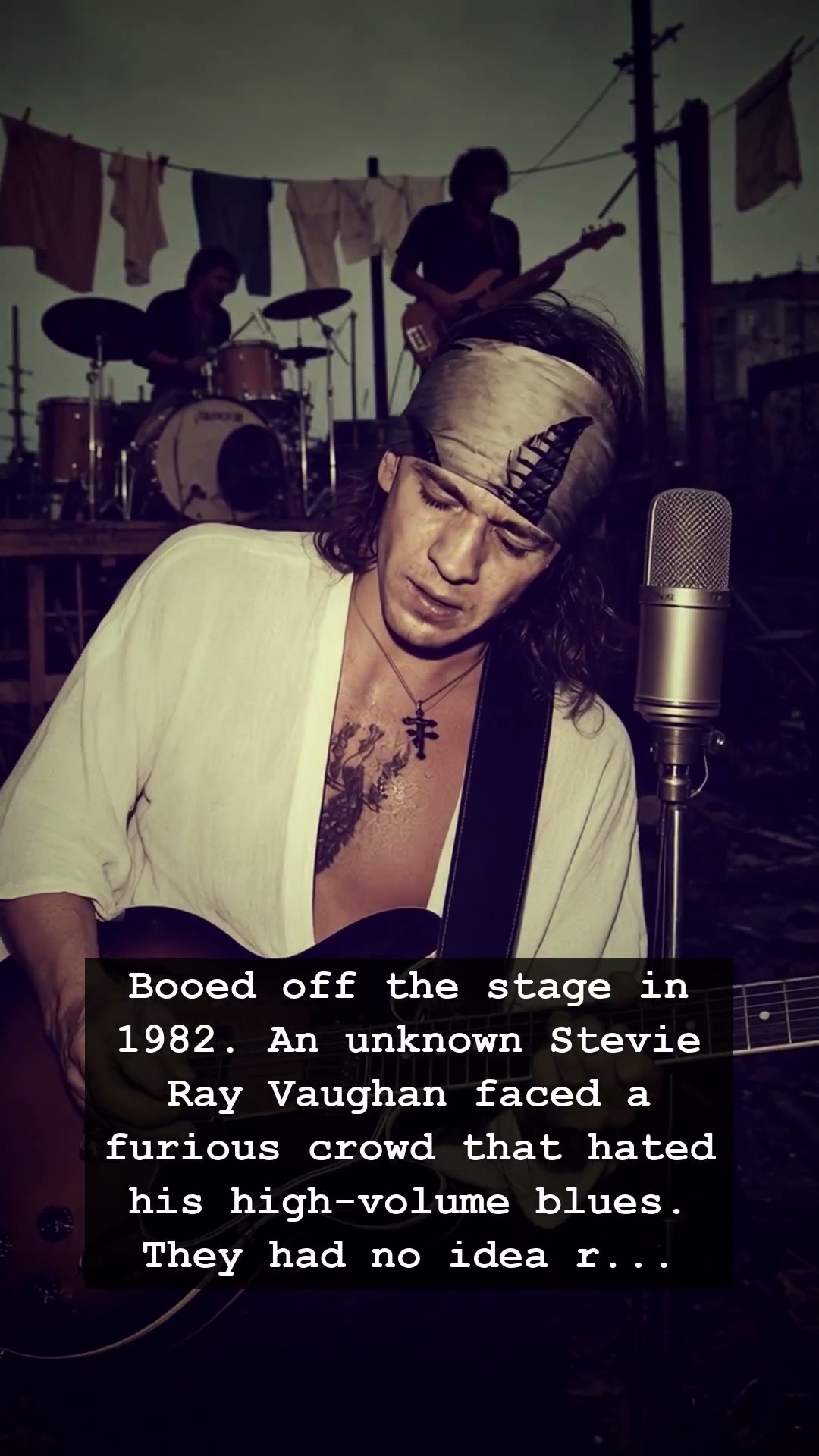
It was 1982 at the legendary Montreux Jazz Festival, a sanctuary for jazz purists who expected refined solos and quiet, sophisticated arrangements. Instead, a young, frantic guitarist named Stevie Ray Vaughan marched onto the stage with his iconic felt hat and a battered Fender Stratocaster. He cranked his amplifier to an ear-splitting volume, unleashing a torrent of raw, aggressive Texas blues that felt like a physical assault to the conservative audience. The reaction was immediate and brutal. Within minutes, the crowd began to boo, their voices swelling into a chorus of rejection that drowned out his blistering licks. Stevie Ray Vaughan, standing alone in the spotlight, didn’t flinch, but the humiliation was palpable as he was effectively run off the stage by a sea of disapproving faces.
What the crowd didn’t know was that while they were busy jeering, music royalty was watching from the shadows of the wings, mesmerized by the sheer intensity of the performance. Among those in the audience that night were David Bowie and Jackson Browne. While the festival attendees saw only a loud, unpolished nuisance, these industry titans saw a revolutionary force of nature. For them, the chaos onstage was not a failure; it was the birth of a new era of guitar heroism. The disdain of the Montreux crowd became the ultimate irony, as those very individuals were essentially booing the man who would single-handedly resurrect the blues for a generation obsessed with the sleek sounds of synth-pop and disco.
Stevie Ray Vaughan was a man out of time, a throwback to the grit of the 1950s blues masters, yet his delivery possessed a modern, electrified power that hit like a thunderclap. The rejection he faced at Montreux became a defining origin story—a moment where the artist’s raw authenticity collided with the elitist expectations of a changing musical landscape. It is a haunting thought to realize that one of history’s greatest virtuosos was nearly discarded because his sound was too honest, too loud, and too bluesy for a room that preferred polish over passion.
Behind the scenes, the internal struggle of the era was shifting; the glossy production of MTV began to take over, leaving little room for the dusty, soulful resonance of the blues. Yet, Stevie Ray Vaughan became the bridge between the old guard and the new. He carried the spirit of the Jukebox era into the heart of the 1980s, proving that even amidst the neon lights and commercialized excess of the decade, the soul-searing cry of a guitar string could still command the world’s attention. He transformed his humiliation into a fierce, lifelong dedication to his craft, rising from that ignominious stage to define the sound of an entire generation.
Today, we look back at that night not as a tragedy, but as a testament to the resilience of true artistry. The Montreux incident remains a reminder that greatness is often misunderstood in its own time. Whether you were there in the crowd or discovered his albums through the scratchy vinyl of a thrift store find, the legacy of Stevie Ray Vaughan continues to vibrate through the history of rock and roll. He proved that even when the world tells you to go quiet, the best response is always to turn the volume up, close your eyes, and play the blues until the world has no choice but to listen.