
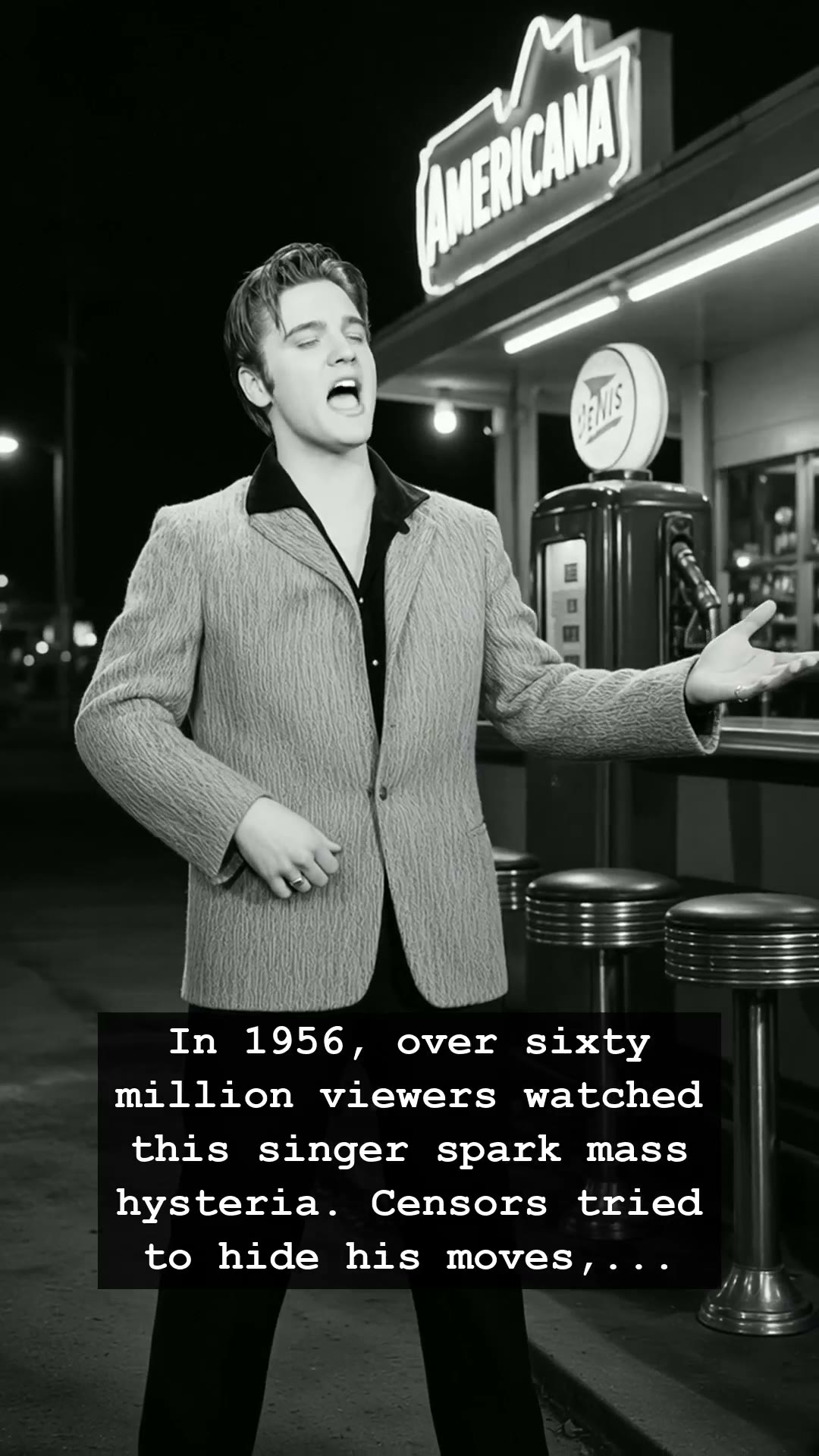
It was 1956, and the living rooms of America were about to be invaded by a force they could not possibly comprehend. When Elvis Presley stepped onto The Ed Sullivan Show, the air was thick with a tension that felt more like a ticking time bomb than a musical performance. Sixty million people—a staggering portion of the American population—tuned in, their eyes glued to flickering black-and-white screens. They weren’t just watching a performance; they were witnessing the birth of a cultural earthquake. As the young man from Tupelo moved with a raw, kinetic energy that defied the stiff social norms of the post-war era, he didn’t just sing; he provoked, he tempted, and he undeniably changed the trajectory of popular culture forever.
Back then, the world of the mid-fifties was meticulously polished, governed by strict codes of conduct and the soft, polite crooning of traditional pop icons. Enter Elvis Presley, a hurricane of rhythm and blues influence, black hair, and a hip-swiveling charisma that terrified network censors. The powers that be were so rattled by his presence that cameras were famously instructed to film him from the waist up, desperately trying to crop out the gyrations that sent teenage hearts into a frenzy. They thought they could sanitize the spectacle, but they were sorely mistaken. By attempting to hide the forbidden, they only amplified the allure. The rebellion was already in the room, and no amount of television censorship could suppress the electricity crackling through the air.
This wasn’t merely about dance moves; it was a watershed moment where the repressed desires of a generation finally found a voice. Elvis Presley became the lightning rod for everything the older generation feared: the influence of R&B, the rise of the teenager as a distinct cultural force, and the loosening of moral boundaries. While the parents in the room might have turned away in dismay, their children were mesmerized. This was the era of the Jukebox, the diner booth, and the newfound freedom that defined the youth experience before the arrival of the more cynical sounds of the later decades. Elvis was the gateway drug to a new world.
Years later, as we look back through the lens of history, we see the profound impact of those sixty million viewers. The performance served as a catalyst that accelerated the decline of the traditional mainstream and ushered in the era of Rock ‘n’ Roll. It was the prologue to Woodstock, the precursor to the wild spectacles of the later decades, and the foundation upon which every rock star would eventually build their stage persona. The sheer drama of that night lingers in our collective memory, a snapshot of the exact moment society realized it could no longer hold back the tide of cultural change.
Today, the legacy of Elvis Presley remains an untouchable pillar of American music. We still feel the echoes of that 1956 broadcast whenever an artist dares to challenge the status quo or push the boundaries of performance art. It reminds us that music is at its most powerful when it is slightly dangerous, messy, and unapologetically real. As the dust settled and the screens went dark that night, one thing was certain: the world had irrevocably shifted, and we have been living in the shadow of that magnificent, defiant performance ever since. Does the memory of that legendary night still make your heart race just a little faster?